price-compare results for meta vendor sites

Auth:
Title:
Kywd:
Showing posts with label Bookstores. Show all posts

13 February 2007

500,000 Books and CDs are Buried in a Landfill Deliberately by the City of Longueuil, Québec

2 comments

La Presse


Tuesday, 13 February 2007
by Émilie Côté

500 000 livres au dépotoir


Paul Saindon, in front of the landfill site at Saint-Nicéphore where his 500,000 books and 30,000 CD disques were dumped.
Photograph Robert Mailloux,

La Presse

(Montréal)

Blogaulaire was book picking in a 'friperie'. He began discussing 'better' places (better prices)with the only other customer, a man searching titles next to him on the next shelf over. And then the guy told him about all these books being trashed on the South Shore, near Longueuil, Québec. So I am blogging this horrible story.

Yes, it is horrible and the City of Longueuil did not have to destroy this huge stock of music, literature, history . . . and who knows what other documentary treasurers! The city had possession of the material, the city was storing the entire lot on city property and decided, through its ultimate domain (and ignorance) to trash everything!

Paul Saindon had a bookstore on Chambly Road in Old Longueuil with a floor-space of 4,600 square feet. Saindon himself (Blogaulaire never visited it) describes the local as a bookmans 'Ali Baba Cave'. As is typical, the landlord raises the rent 25% after the first 5 years of operation and the bookstore owner finds cheaper digs, but smaller; in fact so small he cannot accomodate his stock.

The collection, which runs the gamut from the mid 19th centure to today and includes all the highs and lows of North American literature as well as music - - with all the greats of Québec culture represented in multiple editions and formats - - is left to the whims of an unsympathetic landlord and a city administration uncertain of its role, uncertain of anything it seems.

The city did pressure Saindon to claim his property after putting it in storage. When Saindon could not find a buyer and was unable to come into the municipal warehouse with enough helpers to sort the books, according to the City Clerk, nonprofit cultural associations in the area were offered the books free of charge.

The whole story suddenly becomes confused and cloudy. Interviews to track down who was offered what by whom seem full of contradiction. It does appear that Saindon was making an honest effort to save the collection by contacting community centres, cultural groups, probably the municipal libraries.

Whoever did or did not refuse the collection (which was a total mass of tumbling piles by now) the final decision was taken and acted upon. Everything was dumped like so much rotting refuse into the Saint-Nicéphore landfill dump and is now utterly beyond salvation.

Everything was carted off on January 29, 2007, which is close to the date that on the north side of the St. Lawrence River, Montreal was throwing George Butcher out of his apartment for stockpiling nearly 15,000 books and documents in his home. See the article HERE.

There is nothing yet that I can offer as a conlusion or summary to these stories. These situations are both personal and collective challenges in this and probably in your own community. I blog the news; I invite discussion. I will pick up this thread again.

Consider using the Google Language Tool to read the La Presse article in English if you find wading through the French text onerous. Just copy the address url of the title of this post into the 'Translate this page on the web' box under the language page options offered by Google. Most of the translation will be useful. Just prepare yourself for half a dozen 'false friends' between English and French. A couple phrases are real gems (I tried it) and you will have at least one hoot while you cry over the tragedy of this heritage being destroyed totally by mindless boobs who are paid by the public purse.

10 February 2007

Nobody is an Authority on Nuttin' - But We Try

1 comments


Blogaulaire likes to jerk people's heads around . . around the very same issues he finds his own head is being jerked around. I guess misery loves company, or something like that.

Perhaps I think that I am an iconoclast. I like to break up other people's preconceived notions and the icons of complacency that rule in their thinking in their little niche, their little nest. I would like to think of myself as a radical, able to 'get at' the root of, the core of, things . . without pussy-footing around with other people's preconceived notions.

But what those descriptive, value-laden words above amount to is merely one more of the most familiar North American stereotypes that are current (and have been for a long time) current among the ranks of Young Turks practicing journalism, literature and/or among today's million-member mass of the scribes who blog on the Internet today. So even THAT image of me as an iconoclast is hardly worth a hill of beans!

There are many, many challenges facing the bookselling trade today.
And there are many, many booksellers who are failing to meet these challenges while many others are succeeding financially in today's market. Where I place myself is as one who is outside this sort of mêlée yet one who can, while learning from others, see through many conceptual traps booksellers are laying down for themselves as they attempt to see through each challenge that presents itself.

Blogaulaire refuses to jump into the groove of those who complacently argue that somehow 'we' (the booksellers) will muddle through. And I see a large gap between the successful booksellers who fit neatly into their local community of book readers/bookstore patrons and the unsuccessful ones who have not made a similar organic connection with their own local book-buying public.

At times, pessimistically (with a touch of hubris, admittedly) Blogaulaire smirks at the emails on a listerv written by wise-old book purveyors who seem totally preoccupied with queries about how to connect with buyers on the Internet. I say to myself, self says I, maybe they should first start worrying about their disconnect with their own local community. In fact, I know deep down that these wizened owners of brick 'n' mortar bookstores have given up on their own local community because that particular community is no longer rushing their bookstore to buy more books!

So people who no longer have a face-to-face community are looking for a virtual community. But, wonder of wonders, it seems that everybody and her brother is searching for the same thing! They are all uploading their titles to the half-dozen or more meta-vendor websites and, generally, slashing their prices. The iconoclast in me says "Duh?". The realist in me asks "What do we do about it? How do we resolve all these obvious disconnects between these book sellers and their clienele, and the book suppliers (the pickers) who are suddenly The Competition?"
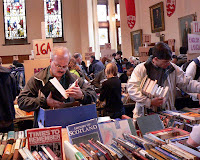

What I see that is stable and continuing to flourish surrounded by this maelstrom of turbulence is the voluntaristic approach of non-profit book fairs, such as the University of McGill's and the Sir Thomas More Institute's book sales in Montreal or any one of the even more local sales such as Verdun's St. Willibrord's Church's monthly event. (Plus, I could name a dozen mor local book fairs on the West Island).

Obviously, the worst prescription to offer to anyone working to put meat on the table is to tell that person to go out and volunteer their time and forget about earning money. Yet there are elements of the book fair that can be brought into the formula for the commercial boutique bookstore owner.

Let me just name a few for starters with the caveat that more experienced people could parse such a list better than I could discuss these issues.

Publicity. The fairs are announced in public service announcements in the local papers.

Support. Large numbers of residents attend because it is 'for a good cause.'

Price. Everybody expects bargain prices - even the pickers who intend to list their treasure discoveries on ABE and e-Bay.

Timing. The events are announced well in advance and last, at the most, a couple days.

Space. Charity events do not pay rent and they have access, normally, to vast spaces such as auditoriums and church basements.

Volunteers. The grunge work is done by unpaid, usually enthusiastic, members of the community.

Expertise. Retired leaders from the bookish professions serve as unpaid co-ordinators.

Few constraints to turn a profit or pay out a percentage. I think I'm on weaker ground on this one. Maybe there is more pressure from 'the administration' to turn in a good income than some of us realize.

I think I've listed enough elements that describe the volunteer sector of used book selling. Let me just list another, singular, element -- then I can pat myself on the back self-righteously for being an iconoclast:
----------------------------------------------

One thing that
The book fair people know --


HOW TO TAKE OUT THE TRASH
WHEN THE PARTY'S OVER !!!


I think that commercial bookstore owners have a handle on ALL of the basic elements listed above -- or at least they seem to in their own email discussions -- but that as a group they are unwilling to air-out in public purview two subjects. The following points are the dirty laundry of the book trade.


What is not being discussed, in my humble opinion, follows:

When a bookstore no longer enjoys local, public support, the owner has to be hog-tied and practically tortured to admit this is so. Not that I think all this is their own fault. But book people really do need to take personal ownership of how, why and the commercial consequences of losing the support of their local community.

This seems fundamental. Especially in communities where the book fairs thrive and the bookstores do not.

The second point is neither openly discussed by the book fair people nor by the bookstore owners, viz: How do you get rid of the left-overs at the end of the day?

Because, if and when the book event and sales venue has community backing from the grassroots, that same public will inundate you-the-bookseller with all kinds of books, including titles that no one in his or her right mind would want to purchase and take home. And to stock and store these books at your own expense will cost YOU money and/or valuable resources like floor space.

Do you send these leftover books to Africa on the next freighter out? Then pity the poor Africans is what I will add. (But of course you don't send them abroad . . that, at least, is one urban myth of the book trade we can quickly dismiss.)

There remains one final point to all this: The book fair people do try to head off the magazines, old newspapers and unsalable print material at the door before it becomes a burden to their organization. But when the commercial bookseller tries to head off 'trash' coming in from a regular, loyal customer, this puts the store owner in the role of a snarky, penny pinching and mean gatekeeper.

But who knows. Maybe the next load of books this same patron drops off will be loaded with priceless treasures?

You don't want to look mean to such a bountiful supplier as this well meaning customer, now do you?

At the end of the day and the end of this long post, what I advocate is that bricks 'n' mortar bookstore owners try to emulate that same communty-based formula that works so well in the volunteer sector I counsel all of us to remain as graciously in the good graces of even the most benighted client. Be as friendly to them as possible.

The shopkeeper must have a quick EXIT STRATEGEY. A backdoor procedure that centres around some local friend with a good pickup truck. A guy or gal who will help haul all of what is mere 'printed material' from your store's receiving end to the shipping end at the back of the store -- STRAIGHT to the collection bins at the local recycling or paper-drive collection centre!

Short of everybody closing shop and operating out of their own basement or apartment, Blogaulaire's proposal to bookstore owners about reconnecting with their communities (while still remaining Spartan about display and storage space), PLUS the idea of holding big open-door sales evebts, are topics that deserve more wide discussion by book bloggers and subscribers to bookish email listservs.

08 February 2007

An Open-Ended, Unending Rant on Used Book Selling

1 comments

At an open-air flea market about 6 years ago, amongst my junk on a table I had a few books. paperbacks mostly if not entirely. I put a price of $15 on my copy of Naomi Klein's book "No Logo". I just knew I would get the price I asked, never mind what I paid for the book (probably at another flea market) myself. It sold for $15.

This summer, if I sell some junk there again, it will be pretty much the same routine, though my computer parts and peripherals probably won't sell as well as they did back in 2001. I'm not certain what the $15 paperbacks will be, maybe it will include a French-language copy of Yann Martel's novel Life of Pi.

What people will want most this year in Quebec is very different from what it was 5 or 6 years ago. At a flea market I have no problemo adapting. But, in a well stocked bookstore, I can see these changes in 'taste' presenting a very serious problem. (One sells 100s of diverse titles 'all at once,' so to speak.)

I remember from days spent in Chicago a period when there was a craze over every printed title about surrealism. Maybe it was local, probably not. I remember from Montreal entire knick-knack and lit boutiques devoted to New Age, to the Cabala and crystals and tarot cards and nuatl-whatever mythology. Folk music and disco were also in, then out.

I know, there still exists a solid-selling literature that includes Gabriel Garcia Marquez's 'One Hundred Years of Solitude'. I hope this bedrock lit also includes Cervantes's 'Don Quixote' but I forget. I believe Octavio Paz is out today and Carlos Fuentes is in, but I'll pass on that one as well.

The bookseller people who are specialised in one genre, say science fiction or, say, comic books, probably have a better handle on these changes in taste than I do or than most used book store owners as well. And these specialist dealers know which title & author ages so well so they pop that one straight into a Mylar baggy affair. I suspect that many of the mainline booksellers, however, operate on not much more than a hope and a prayer, plus lots of shelf room, when they decide to stock a particular book. Or do they just stock everything that comes their way?

Let us not underestimate the genius of SOME used booksellers to adjust to The Long Tail (the eternity of demand), their sensitivity to local preoccupations and who is or is not a celebrity, or their grasp of the world historical trends. But from looking at sellers closely, I seem to see an equal amount of plain old good luck, like when somebody dumps freebies on one bookseller's doorstep and that lot fetches hundreds of dollars the next day!

What this world needs is a good computer program, distributed widely to the trade we are discussing, that tells sellers what to do in lock-step with what will sell well. Barring this prescriptive, management-by-prediction, hardwired map, booksellers will remain hard done by. End of paragraph.

So far, despite my appeal for a software program to solve every body's problems, I have not said one word about the Internet. Nor am I going to. It's been discussed thoroughly enough, even though you wouldn't be able to read these line without it.

Bookseller are condemned to be "overstocked" when tastes change rapidly and dramatically. Not only would efficient operations require a guerrilla army of suppliers to stay in stock with what's HOT but efficiency would also demand a guerrilla army of disposers (if not buyers) to get rid of what is NOT HOT, what is in fact quite COLD.

Publishers used to dispose of their 'overstock' at a quarter to job-lotters in the remainders trade. (Now that they print less, I guess it's up to fifty cents per book.) The used book dealer, though, living life at the bottom of the food chain, cannot pass on his stagnant paper and board to an even lower bottom-feeding odd-lotter. Wishing it were so does not make it so, so sorry.

This is why I am skeptical regarding the long tail optimistic approach toward the hoarding of books. It is so much a case of the wish being father to the thought that it borders on being pathetic. Relying on the long tail finishes up with what I saw today on Bibliophile Bullpen: an engraved tombstone reading 'The one who has the most books at the end wins.'

My post is here not to offer solutions but to offer very subjective impressions, nothing more. Here are my subjective reactions regarding book hoards.

First: that the dealer has little discriminating judgement. The stock whatever gets tossed over the transom;

Second: that I should low-ball to get the absolute dirt-cheap price for what I would otherwise pay a premium for to own;

Third: that if the entire stock is not readily at my finger tips but is in the basement or behind glassed-in cases, that it is the bookseller who is trying to cheat me and not vice versa (which is how I'd rather it be);

Fourth: (this is the hard one) I feel real repugnance at seeing row after row of titles that were once my true 'flames' but with which I have had a bitter falling-out, viz certain unnamed conspiracy theories, New Age treatments of Atlantis or Nostradamus, recent books about 'Empire', true crime fiction of the poltergeist sort, etc., etc.

I do not intend my oh so subjective list to be a put-down of anyone (I could have used more judgemental language, but held back). I'm merely underscoring some of the dangers of trying to be everything to everyone. And I think that keeping everything from every reading craze threatens being slotted in the customer's mind with being nothing to nobody.

There is a bookseller friend of mine who stocks whole sections of books in Renaissance Literature. These are equal in shelf footage to her offerings in Esoterica as well as her stock in Communism. I take that back, if you include Religion, the esoterica far outweighs the Marxism et al. And the stuff on First Nations and Judaism tends toward the occult. I don't know where to place the vegan cookbooks: do they go with the political or the religious? In any case, this is definitely an 'alternative' bookstore. But the vast majority of her trade is in popular fiction, of which she stocks more than all the other categories combined! Need I add that financially her bookstore is in ruins!

You get the picture. The bookstore might do fine on a college campus, but, unfortunately, is located in a working class district with a 50%+ high school dropout rate. Go figure!

If I had a prescription to offer the owner of a bricks 'n' mortar bookstore it would be to not attempt being all things to all people: something that your customer base is not into. Or at least to have no more than two public faces, one for the carriage trade and intellectuals and another for the local market -- but have all your stock within easy view and arranged based the target market for the books. Classics and Philosophy do not mix well with popular snuff lit and Harlequin romances. If you hve to stock Readers' Digest Condensed to get by, just forget it all!

(This post has been edited to exclude from purview all the complications arising from doing any and all of the above in two languages simultaneously.)

Has David Streitfeld at the L. A. Times Revealed to Booksellers a New Prophet-Poet? Is the Prose Proselytizer of Books Now in Print?

0 comments

Shop Lewis Buzbee's book "The Yellow-Lighted Bookshop," (US $17) online if you want to save mucho. Just use the form box at the top of this and every other page on Cheap Priceless Editions.

Streitfeld's piece is a remarkable one-shot summary of the crisis that metropolitan bookstores in North America have been facing over the past 6 or 7 years. Truly, this is not at all like the stereotypical occupational complaint the way hog and milk producers bitch about subsidy programs. On the other hand, there is always the trap of psychosomatic sympathetic identification with the Californication of Culture. You make up your own mind.

Maybe Ron Silliman is the new prophet-poet of what is happening in the book trade. He's at least eloquent and articulate, coming up with apt comparisons with past techno-family challenges.


Quotes from:
Bookshops' latest sad plot twist
By David Streitfeld
Los Angeles Times
February 7, 2007

QUOTE:
When sliding sales forced Cody's to close its store next to the UC Berkeley campus, the poet Ron Silliman wrote on his blog that it was once the anchor of "the best book-buying block in North America." But in the discussion that followed, the attitude was one of resignation if not indifference.

"Why would anyone want to perpetuate small independents by paying higher prices?" wondered Curtis Faville, a poet who sells rare books on the Internet. "Most of these proud little independents were poorly run anyway."

Less harshly, Silliman suggested in an e-mail that "we're simultaneously caught in the wonder of the new and true mourning for the losses of the old."

It's an unsettling if inevitable process. Half a century ago, Silliman said, he would play chess and checkers with his grandfather as they listened to the radio. "That stopped once the TV arrived, because now we all had to face the same direction," he wrote.
END QUOTE--------------
hippie cowboy hats
If you think everything '60s started in California, then you probably think everything '60s will end there.

Blogaulaire thinks that the last thing these California scribes will write about is the large number of ex-patriats who have left the state to discover some other New Eldorado elsewhere. Native Californians would much rather believe that Silicone Valley (with, perhaps, a little help from Seattle) still RULES; that we're all into California Dreamin, one way or the other.

On another personal note, Berkeleylost its magnetic appeal along with The Haight so long ago . . it was almost exactly on my 15th birthday. The point is: the demise of these culture icons up and down Shattuck is not the demise of The Culture ipso facto.

I'm even surprised that Cody's survived in that venue for as long it they did. (Blogaulaire still adores North Beach bistros in San Francisco.)
--Blogaulaire

QUOTE:
"The bookstore as we know it is in dire straits," said Lewis Buzbee, a novelist who spent many years working in the local shops.

"The Yellow-Lighted Bookshop," (US $17) Buzbee's loving memoir of his time as a clerk in the Bay Area (is) interspersed with a history of the bookselling trade, has become a small but genuine hit. It's just gone into its fourth printing, with enthusiastic crowds flocking to the writer's appearances.

"One thing books do is offer us concrete definitions for sometimes hazy feelings," said Buzbee, 49. "My memoir gives people a venue for sharing their emotions about bookstores."
--------
A good bookstore, he notes, is unlike any other retail space. Where else can you linger, sample the merchandise and then casually reject it if not quite right? Your local pizzeria would frown on such behavior. In a culture that worships money, bookstores are one of the few commercial institutions where cost doesn't trump all other considerations. Massive bestsellers share shelf space with the most obscure tomes.
Buzbee exalts a place where time seems to slow but hours can disappear in an instant, where browsers coexist in a companionable solitude, where a chance encounter with the exact right volume might create an explosion in your head.

"Not only could your world change, but the rest of the world could change," he told an audience at the venerable City Lights bookstore in North Beach."
END QUOTE