price-compare results for meta vendor sites

Auth:
Title:
Kywd:

13 December 2006

Bookstore Flounders: Holiday Book-Buyers Give Us a Cold Shoulder

0 comments

If you are looking for a web link to this post, stop. Most of the background to the story & this post are there in Cy's profile or are archived on this site already.

Early on, Blogaulaire decided that dissing 'the Management' was becoming too personal, so I deleted the nasty posts. All the readers I consulted before trashing these rants agreed in principle. But then they bugged off from Cheap Priceless Editions for their daily gossip, because the juicy part was what attracted some of my friends in the first place.

Well feast today while the bookstore languishes in famine.

My own personal involvement as a part-time worker at 'Sandra's Books' is unsustainable now. This is due to a fundamental problem - money. Each of us who work in the bookstore alone from 1 pm to 6 pm on weekdays and even the owner, who also puts in two 1 pm to 6 pm shifts (Saturdays and Sundays) plus two later shifts from 6 pm to 9 pm (on Thursdays and Fridays) lately have toughed out these zero-sales days. Obviously it is disheartening. The frequency of days open with no sales seems to be growing as the holidays approach.

Some of the owner's friends have helped out gratis (these are my friends as well, and I should include my own 11-year-old daughter here). Several of us have tried to straighten up in all the aisles and within all the nooks and crannies of the various subject sections. Over the past several months shelving has been built, duplicate copies stored away, displays rearranged - but to no purpose. Sandra undoes our efforts, claims she has her system (implying strongly that she is on top of things which is patently untrue and evident to everyone who enters her bookstore - they say this without mincing words).

With the constant in-flow of more boxes full of donations, boxes of 'everything imaginable printed on pulp & paper', and the owner's obvious fixation on hoarding it all, whatever order any of us have tried to make out of the mess has been buried under the accumulated rubble.

Well, maybe it's not THAT bad. But wherever and whenever anyone other than the owner makes headway at arranging the surplus of books piled on the floor in one corner of the bookstore, we are made to feel that we have just 'stabbed her in the back' by messing up her efforts at 'properly arranging the books'. This is not an exaggeration. If this is not a formula for discouragement . . well the disappearance of even the regular clientele who should now be getting into the holiday buying spree spirit (wish, wish) . . that certainly is discouragement.

Quite recently there have been other developments of a more private and personal character. Not between the owner and any one of us who work for chump change or who volunteer our time. I won't go into it. Only to say that it is all starting to look so thoroughly neurotic in scope and depth that a couple of us 'in the know' are throwing up our arms, fingers and feet in disgust. We will merely 'float away' with all our limbs engaged in mid-air like that vis a vis Sandra. She is the one who will land smack on her ass. That is our prediction (and I DO write here for more than myself).

Sandra is the first person who will tell you that if there is something wrong with the bookstore, blame somebody else. Does she also believe that if there is something good about the bookstore she is the only person who deserves credit? If she does think like that, it is a perfect formula for what is happening. Her community is deserting the store. The passengers onboard are jumping ship. In extremis, as the situation appears to be at this crisis juncture financially, none of us have the leisure to debate whether the ship hit the iceberg or whether the iceberg rammed the ship. Most of us think that the collision occured in broad daytlight and that if the captain cannot tell what happened, the least the captain can do is lash herself to the mast and leave us one more place to save someone more innocent of complete disaster.

12 December 2006

Battle in Seattle - Vancouver Crew Re-enacts the Clash of 1999 for a 2007 Movie !

0 comments

Is Flickr Showing Us the Movie - Or Is This from the Archive?: "Battle in Seattle - a 2007 movie release

When a film crew films dummie demos about huge real demos - still remembered vividly by the now 'ageing 20-some' movie reviewers (some 8 years after Seattle) the reader can really sense the Adrenalin-flow in every phrase of copy content. I can share it, though I admit that this sort of thing is the height for definitions of what is seriously self-referential; it can turn into one more progressive's contortionist act of gazing at his or her own belly button.

Bob at flickr ran photos of the scripted WTO counter-globalization demonstrations taking place this week in Vancouver (Year 2006). I cannot tell the film version from the archived real images. I don't even try!

Let us see if we can upload an image:


This was being filmed this morning at Robson and Homer, Vancouver, BC.

Eight years is approximately half the lag-time between movie and realtime protest movements and struggles. Have we moved that fast lately so that today 8 years = 16 years of the 20th century . . or is the time warp only affecting these global trade issues?

------------------------- Quote (below) from flickr.com

View Bob_2006's map

Taken in Downtown, Vancouver, BC, CA (See more photos here)49°16' 46' N, 123°7' 01' W49.279495-123.116925

This was being filmed this morning at Robson and Homer, Vancouver, BC.

Director: Stuart Townsend.
Starring: Woody Harrelson, Charlize Theron.

Based on one of the most incendiary political uprisings in a generation, Battle in Seattle takes an in depth and personal look at the five days that rocked the world in 1999 as tens of thousands of demonstrators took to the streets in protest of The World Trade Organization. What started out as a peaceful and successful protest intended to stop the WTO talks quickly escalated into a full-fledged riot and eventual State of Emergency that squared peaceful and unarmed protesters off with the Seattle Police Department and National Guard. A 'ticking time bomb' political action-drama in the vein of 'Crash' and 'The Constant Gardener', Battle in Seattle intertwines points of view of all facets of this infamous event. Our lead characters are protestors, pedestrians, politicos, police, delegates and doctors. No perspective is left untold . . .

11 December 2006

Comparing Hollywood Trailers : 3rd World Genre 01

0 comments

Blood Diamond

Hollywood: The Human Juice and Fizzy Swirl Soda Bar. Reality in, flaming yet frosty entertainment out.

Comparing Hollywood Trailers : 3rd World Genre 02

0 comments

Babel trailer

This Babel flic's trailer may qualify as the generic neo-colonial Hollywood adventure (African, Near Eastern, WhatHaveU) as near as a blockbuster film will come to social commentary (a la Hollywood post 9-11). From YouTube - now You can register a COMMENT on Cheap Priceless Editions or you can reach a wider readership with a COMMENT on the YouTube site directly.

Blood Diamond : Is this Flic a 2nd Fiddle to The Constant Gardener?

0 comments

KPBS Movie reviews » Blog Archive » Blood Diamond:

"Zwick is not content to just tell a good action story or to focus tightly on one aspect of a complex problem — he wants to explore everything. He shows how the guerrillas coerce children into fighting, how diamonds fund the violence, how the west ignores the problems in Africa, the formation of massive refugee camps, and so on. Yet even though the film covers a lot of ground, it never gets to the complexity of the problems. It’s broad in scope but not deep."


Edward Zwick directs Leonardo DiCaprio and Djimon Hounsou.


Reviewer Beth Accomando goes on in the filn review to add negative comparisons of Blood Diamond to the film version of the John ie Carre novel The Constant Gardener (TCG. Toronto, Penguin, 2001 ISBN: 0 14 10.0169 0; Blood Diamond which is not a novel adapted for screen, opened 08 Dec in US cities / TCG ran last year and is available in DVD format for rental).

A newcomer to blogging, S Nathan Lee on his blog Gin House Blues just reviewed both flics and critiques both for offering cartharsis as relief for 'our' White Colonialist Guilt (in a word). Blogaulaire just commented at Gin House Blues to back up Lee's critique because all of these Africa-themed novels and films (including Gil Courtemanche's Sunday by the Pool in Kigali and Hollywood's Hotel Rwanda )arrive on cinema screens at least 10 or more years after the disasters that they describe. This reminds me of Vietnam War films with the obvious twist involved for Africa.

I am nearly certain that the reviewers will go Political Light (and PC) on Blood Diamond and other upcoming additions to this 'bloody Africa' genre while ignoring the background for the stories.

Any reviewer has a right to slight the political realities because this is 'just entertainment' after all. Does the obligatory love story enthral viewers or does it fall flat on the rear-end? Rear ends are as important to this genre as are the tie-ins to corporate crime. And some semi-serious periodicals running Arts & Entertainment reviews keep that department very far away from the World News and International Politics pages -- as all advertorials should be placed apart.

Where reviewers should not fall down, however, is in the zone of film edits. Ex: here in Canada we made much of le Carre coming to Manitoba and Saskatchewan to research background for the his TCG book. Then the director set up what were regarded as key scenes in the Canadian locales. Reviewers of the filmmaking phase (as they often do for local connections that boost local economies) told us that the reason the fictionalised version featured Canada was related to a real-life Canadian medical researcher who had to fight tooth and nail for the right to publish her clinical trial results while the pharma company that contracted the research fought even harder to prevent this disclosure of negative results.

Well and good. Those who had followed the news item about medical publlshing and big pharma were delighted that a blockbuster film might bring down a bad blockbuster drug.

When I watched The Constant Gardener on DVD there were no scenes from Canada. There were credits for the filming in Canada, however. And in the feature section of the DVD those scenes were shown. They were cut from the video (and presumably from the film) version.

Did reviewers at the time TCG came out make the cutting-room floor connection? That the filmed murder of a drug investigator - the hired hit that targets a faculty appointed physician standing up to pharma - was cut frrom the final version of the film? Was the dramatic action from the Canada shoot too dramatically documentary to be rolled out with the romantic and less focussed crimes set in Africa?

I will be checking out some of those older reviews and awaiting a chance to view Blood Diamond in a theatre. Prediction: in 6 to 8 years we will have a book-film rise to the top of the entertainment pile that deals with the crimes and career of US educated US ex-con and ousted Liberia's tyrant Charles Taylor. But even after the delay, the book-film I predict will leave Pat Robertson's evangelic bankroll for phony gold mines to prop up Taylor - all the bits tying African exploitation to the big lobby of Congress in the States - the focus on North Americans in other words will be left unused on the cutting-room floor.


GRIPPING (sic) CONFLICT: Djimon Hounsou, Jennifer Connelly, and Leonardo DiCaprio star in 'Blood Diamond.'
WARNER BROS. PICTURES

The last word in this post is reserved for the film reviewer from KPBS, Beth Accomando:

Films from Africa, made by African filmmakers are few and of those few only a rare one ever makes it to American theater screens. All the films we’ve seen recently of Africa — Blood Diamond, Catch a Fire, The Constant Gardener, Biko, The Last King of Scotland, Tears of the Sun—are all very western in terms of their narrative structure. Films from Africa by such directors as Sembene Ousmane or Djibril Diop Mambety have a very different storytelling quality to them that stems from an oral storytelling tradition. It would be nice to see more films from a genuinely African perspective make it to American theaters.

09 December 2006

AddAll Search on Brad Vice's The Bear Bryant Funeral Train

0 comments

A controversial book. Accusations of plagiarism. The vultures are circling over a tiny speck on the landscape of US publishing. The book is pulped but has the carnage only started? It must be over when the vultures head off in search of fresher game.

But coming in low and fast, leaner carnivores start buzzing the scene in ever tighter circles. You can spot the letters UB & RBC** emblazoned on the undersides of their buff wings, so they must be a new life form, some mechanical monster only camouflaged to look natural.

The more apt metaphor we are more familiar with than with the one I painted above is found in the phrase "there is no bad news in Rock N Roll." . . not a metaphor at all.

I decided to use that box pasted above all the CPE posts to see if there were any copies of Brad Vice's The Bear Bryant Funeral Train that survived the pulping by the U of Georgia publishers. My question was "How many and for How Much are they going for on the used book rare book marketplace.

Though blogaulaire would prefer that you practice running the AddAll search box yourself from the blog by inputting title and author on your own, the title of this post is also a link to the the page of results that AddAll gave today (it will not necessarily be the same tomorrow if the item sells well).

Here is a summary plus two copies of two book descriptions from that results page:

16 titles offered up for sale and the prices run from US $11.50 to $450

University of Georgia Press 2005 First edition. Hard cover Fine in fine dust jacket. Great shape, like new, never read. Rare copy of controversial book. Most copies destroyed by publisher due to plagiarism controversy. Glued binding. Cloth over boards. With dust jacket. 170 p. Flannery O"Connor Award for Short Fictio. Audience: General/trade.

----------------------------

Athens - The University of Georgia 2005 . 1st edition . Fine / fine . Hardback. The controversial Flannery Connor Award winning collection of stories. This title had to be withdrawn from sale and pulped following accusations that the author had plaigerised extensively from a much earlier book, Carl Cramer`s Stars Fell On Alabama. Consequently only a handful of copies have come onto the market - one copy realizing $ 900. This copy is in a perfect as new and unread condition. Scarce. ISBN 8203 2745 X Athens - The University of Georgia 2005 82032745X1 GB


** USED BOOK & RARE BOOK COLLECTORS

Seemingly Semiotic Sentences Upon Viewing Video Clips Online

0 comments

Browse over to McSweeneys

Then skip over for a view of a couple videoclips at the Wholphin Screening Room

Blogaulaire enjoyed the experience (though my sound disappeared on the long metrage item; long = + 8 min into the clip)

HERE are a few phrases I thought up all on my own to describe the genres of three of the clips that were presented at Wholphin and a couple McSweeney publications I have read:

  • 3rd person voyeurist fiction
    (with a pretense of cinema verté)


  • 1st person confessional fiction
    (with a pretense of honesty without pretence)


  • Feeds from a plain vanilla fixed video camera recording the urban landscape
    (with the pretense of being uncut)


  • Deconstruction of a holiday-greeting-card message

(with the pretense of knowing more than Hallmark Cards)

  • NOT stories. Not built, narrated nor signifying something else. The degree zero POV (point of view).

(with a pretense that POV zero is camp AND profound - not a cliché)

  • Mystery in the banal.

(with the pretense of overcoming the banal via mockery)

08 December 2006

Brad Vice Reacts to Plagiarism Controversy in Alabama, USA

2 comments

See Blogaulaire's Comment:

(Title is the LINK to quotes below:)
A Worse Vice

Remember Brad Vice, the Alabama native who had his book, The Bear Bryant Funeral Train, pulped and who was stripped of the Flannery O'Connor Award for short fiction after being accused of plagiarism? Well, he's got an essay defending his actions in the new issue of Oxford American, and after reading this quote I have a feeling that Mr. Vice might want to drive many a mile out of his way before crossing into the state of Alabama again:

Bear Bryant was always smiling from signs and billboards looming over the highway, and his houndstooth hat was painted on awnings, rooftops, and rotating signs. In this regard, it couldn't have been much different to grow up in Berlin in the 30's or Baghdad in the 90's. I almost called my book The Ayatollah of My Hometown.

Plagiarism is one thing but out-and-out stupidity (emphasis added) is another. If you're going to be selling your book to Alabama fans, people who for the most part put the Bear at the left hand of God Almighty, then you can't be calling him the Ayatollah and drawing even loose comparisons with Hitler and Saddam. It's a bad, bad idea. Trust me, I lived in the state (of Alabama) for too many years not to come away with a healthy respect for the things you can and cannot talk about. I think it was Eddie Murphy who once said that you can speak bad of me all you want but you best not talk bad about my mother. In Alabama, they don't care if you say bad things about Mom, but you damn sure better tip your houndstooth and pay all due respect to the Bear."

END QUOTE

Blogaulaire comment:

I know little about this US-Alabama attack on this author Brad Vice because of his so-called plagiarism. It all strikes me as over-kill by the Alabama University Press and the media, I am glad the author writes in his own defence

What interests me most is how the blog owner at Syntax of Things thinks it a dumb faux pas to make nasty remarks by comparison about your home State (or Province in our Canadian case). The author in question here, Brad Vice, is Alabama born and Alabama bred. In Quebec we know this scenario all too well. There is a hell of a difference between talking about your own experience growing up in Quebec and just plain out and out dissing the other side of the (any, I guess) linguistic frontier.

In my comment on calling Vice 'stupid' for comparing Alabama to Iran under the Ayatollah or Berlin in the '30s, I try to reset the compass of another blogger. Anyone who feels like they are being railroaded by their homeland in the name of homeland identity cum security is very likely to engage in a few exaggerated comparisons with other forms of fascism. IMHO

07 December 2006

The Penguin Blog

0 comments

Penguin - ABE Collaboration:

(From a PENGUIN CLASSICS spokesperson) "next week in collaboration with abebooks we're auctioning off signed copies of all five of (the Designer Classics) - the number ones in each case - to benefit the charity English PEN."

So the link between ABE and the new book publishers grows 'solider and solider' day by day. Pretty soon used book dealers will start debating whether new book sales hurt the market for the used.

If you browse down the Penguin blog, you will be tempted to run out and buy the latest Forbes issue. It is devoted to features about the publishing industry in the face of new digital markets for downloadable content and, basically, entertainment.

Backlists, Libraries, Old Inventory : What Did Archivists Forget?

0 comments

Did you, used bookseller, ever answer the phone and hear a special plea from one new customer who MUST FIND those out-of-print books, documents and periodicals? Sometimes it is from an author-scholar writing a local history from a unique angle about local or regional culture.

That type of call, we all know, will set your mental wheels spinning and may preoccupy your mind while you browse your own boxes and shelves. The next time you are out 'shopping' the tag sales or offering an evaluation - (that euphemism for price bidding) on some estate's 'old books', that one phone call will stick in your mind and, if it touched a nerve, may very much influence what you buy and what you skip over.

This sort of phone call plus email came into the bookstore where I work. It concerned a history of Montreal poets (English-language poets to be a tiny bit more precise) that the caller is writing with a guarantee of publication. Ever since this initial contact, that exchange with a potential customer has preoccupied my thoughts and sent me even deeper into my never-ending research and physical searches for poetry periodicals, chapbooks, collections and even ephemera.

We will be blogging some of what shows up in the coming weeks. Please: if your own experience with selling books has sent you on either a profitable chase or simply another wild goose chase (upon receiving just one serious, potential customer call), if a request suddenly rekindled that flame for acquisition in a specific topic or genre, then please COMMENT upon your experiences on this blog. I promise to respond and try to relate to all comers.

06 December 2006

Used Book Search-Box Above

0 comments

CPE has added a utility for readers so that you have access to as the many, many used book titles currently being sold online. As many book offerings as the current state of Internet technology is able to deliver onto your screen.

(If you wonder, as I always do, "How Many?", try out any book or other title you have lying around the room you are in now.

This search box will remain at the top of CPE's homepage every time you return to read a daily CPE post.*

If you enter: AUTHOR: Betsy Warland
.............. TITLE: left blank
.............KEYWORD: Women's Press

Your search will bring up 46 entries. You can purchase any of them from through the Meta Vendor Sites from the book dealers' entries that pop up after this AddAll webcrawler engine completes the look-up process. (My searches use most from a large list; you can configure your own by customizing these options.)

For the sample Warland search, the number 7 result is copied (without formatting) below:

The Bat Had Blue Eyes

Warland, Betsy 6.99 Biblio Used Book Attic

Georgetown, Ontario, Canada: Womens Press, 1993. In The Bat Had Blue Eyes poet Betsy Warland mines her memory for the secrets of her early years, the storiesbehind the one she knows. "A phenomenal literary experience awaits you here." - London Free Press. ISBN: 088961184x. New /no Remainder Mark. Trade Paperback. New. POETRY POETIC WORKS AUTHOR. Catalogs: Biographies & Memoirs.


Nothing beats trying out the used book searches on your own. Be bold. Put in a publisher and a year in the keyword slot. Try a topical, proper noun like "Kingston, Jamaica". Anything.

Your browser should come back to Cheap Priceless Editions after a search if you hit "Back" a few times. But just in case, bookmark the address; use your 'History' list if need be. But DO return . . often.

* (This is a feature for you; no advertizing revenue comes to me from use of this feature; it was not placed on the page through anything but my personal initiative.)

05 December 2006

African Rockers : In French

0 comments

I Discover a Parisian ROLLING STONE:

Shopping the book corners in resale shops, at least here in Canada, serves as a substitute for loading up on magazines and pulp. Keeping up through periodicals like Rolling Stone, the Village Voice or Liberation and local cultural rags becomes too expensive (in print versions)for most of us (except for an occasional splurge in an airport boutique when on a long trip).

Then there is the Internet.

What is surprising though is that in Montreal the secondhand market is good for finding titles on popular culture. I do not mean the latest issues of magazines because most of these go into recycle bins at curbside in the weekly pick-up (or so it seems). I mean the things like the book I found for $2 yesterday: Helene Lee. Rockers d'Afrique, Paris; Albin Michel, 1988. ISBN: 2226031391

Francophone 'fusion' and rock musicians from French West Africa make Montreal a regular stop on their tours, especially for the Nuits d'Afrique Festival. But unlike the spoken artists of the white-bread North American stripe, fusion and world beats do not set up lit tables at the door and sell both CDs and print material (only the CD is hyped at these venues). We become familiar with the sound but not the background . . unless . .

. . . we pick up what we can in the used bookstores and the recycle shops. Once we discover a book or magazine with a good article (which is always better than the local coverage in the dailies) we can even start building a library with quality and focus without spending a wasted fortune on hit-and-miss purchases.

Quoted below is the Wikipedia entry for the author of the book I found yesterday. Even though 'my' title is 8 years old, Wiki alerts me that Helene Lee came out with a title (2005) in English that is a must read: The First Rasta: Leonard Howell and the Rise of Rastafarianism as well as another (2004) in French that I have to get my hand on: Voir Trenchtown et Mourir or I will be the one who "dies" WITHOUT SEEING Trenchtown.


Helene Lee is a French journalist specialized in Jamaican and West African music.

She started as a journalist in 1979 for Libération and was one of the first to defend the world music in France.
Her early works on African artists helped establish artist like Salif Keita , Alpha Blondy, Ray Lema or Tiken Jah Fakoly. She has published different books related to the Jamaican culture contributing to the development of the reggae music in France and is considered as an expert of the rasta culture. Other works include documentaries and translations.

She took her name after her wedding with a rasta from Negril, Joseph Lee.


Lee, Helene (1988). Rockers d'Afrique: Stars et Légendes du Rock Mandingue. Albin Michel, France. ISBN 2-226-03139-1.

Lee, Helene (1999). Le Premier Rasta. Flammarion, France. ISBN 2-08-067540-0.

Lee, Helene, Davis, Stephen (foreword) (2005). The First Rasta: Leonard Howell and the Rise of Rastafarianism. Chicago Review Press, USA. ISBN 1-55652-558-3.

Lee, Helene (2004). Voir Trenchtown et Mourir. Flammarion, France. ISBN 2-08-068405-1.

04 December 2006

France's Adoration for Edgar Allan Poe

0 comments

Poe deserves every kind of attention we are able to give him as a poet and as a pioneer, including a pioneer in lifestyle as related to one man's artistic production. The Poe I learned in public school did not teach me this. What made me think about Poe's importance and the esteem French poets since Baudelaire have held him in for a century and a half was a couple of puchases I made in book stalls today.

I am not blogging on Poe to name drop or to lay out a lineage of French poetic influences related to this early 19th century American poet (nor to influence my Quebecois readers; I'm addressing American English speakers if anyone). Today I found and purchased one Poe book and a single 33 1/3 vinyl recording of two poems by Poe.

In front of me on the stand with my mouse is the "Golden Treasury of American Verse". This is a "Spoken Arts" recording (Library of Congress Catalog Card Number: R61-382). On the record, the Poe grooves fall between Oliver Wendell Holmes and Walt Whitman. The readings are by Alexander Scourby, who offers listeners with a turntable his fantastic interpretation.

Listening to Scourby, the vowel sequences in the lines, the way he works the enjambements, his subtle vocal rhymes and how he quickly continues unrhymed expressions of connected thought -- all of this goes far beyond the classroom obsessions our readings gave to those hard-line endings with "never-more" as we intoned The Raven.

Scourby's reading of Poe softens the American accent so much it enlightens me as listener and makes me ready to better comprehend the absolute unqualified admiration that the French literati has shown down through time for everything Poe wrote. (Including the other poem on the Scourby "Spoken Arts" recording: To Helen.)

One might think that I'm hanging everything on the fact that Baudelaire bothered to translate Poe (while enthusing over the man). Or that Mallarme' adoration of this American predecessor has unduly influenced me. Or that I am, perhaps, in awe Poe's poetics (I am not). Oh, maybe a little I am.

But let us turn to my other purchase in the book stalls today (which cost me 49 cents minus the 50% reduction "one-day-only" in the discount store).

With this book buy, I discovered that Paris-Match puts out a hardbound collection of Classics; a "numero culturel 'hors serie'". (No comment about the usual crap 'en serie' that Paris-Match puts out every couple weeks in the normal run of their magazine!)

Well, American compatriates, remember how in the school system they offered us Edgar Allan Poe as the poet between Oliver Wendell Holmes and Walt Whitman? In the pedagogical review of poetry as taught, Poe got little more than equal treatment with Emily Dickenson, as we worked up the timeline toward Robert Frost. (One must wait until University before studying the 'American' T. S. Eliot and then the confessional poets ((if we were lucky))- who may include, in more advanced studies, Allen Ginsberg with a couple of Haiku thrown in . . . for the extremely accellerated student). Wait for graduate school for Ezra Pound and maybe Robert Creeley or Ann Carson . . . (Shit, I DID end up dropping names; and Canadian ones at that; SORRY).

Where was I? Denis Levertov? Livesay? Acorn? Earle Birney? No, no. Paris-Match. P-M has no, zero, awareness of Canada nor even Quebec poets of the stature of Gilbert Langevin.

So forget all this name-dropping of Northern poets.

Point being: Paris-Match and all the Parisian media DO fall in the line with their permanent fixation upon Edgar Allan Poe! And rightly so.

In the Paris-Match "collectors' series of special edition in deluxe bindings" the list includes 16 "Giants" of World Literature. POE is the only author listed in all capital letters, and he falls between Victor Hugo and Baudelaire in the magazine's list of the greats. (All of these deluxe books are beautifully illustrated titles that run about 140 pp -- all with copious illustrations in color.

This is a reflection of the regard and exsteem accorded Poe in that country. The featured authors include Dante, Cervantes and Shakespeare, to only name a few in a list that includes Voltaire and Goethe.

Maybe I will blog a bit more on Poe later. I will attempt to receive copyright clearance to upload an MP3 conversion from the Spoken Arts recording as well. I believe that there is a goldmine here for North Americans to better help them understand this fascination that some Europeans retain still for the "original" sources of North American culture . . . and how the 'marginal' in American culture will remain central to what has world appeal around the globe.

02 December 2006

Well Born Melbourne Highway By-Pass

0 comments

Walking Turcot Yards

LEDs, light emitting diodes, provide subtle lighting for the wall of a sound barrier built along several k. of highway leading to this by-pass. Bicycles have their path right next to pedestrians on the natural red pathway and overpass crossing the highway.

What I also find attractive is the photography on this and several other features posted by my friends on Walking Turcot Yards (I hope the photographers form a collective video production unit and travel the world to make a new documentary on urban structures).

In addition to the aesthetics of the sound barriers, it is the level of consideration that went into the Bypass design and construction that are truly worth taking note. Streams, wetlands, grasslands, and endangered species were all taken into account. The local academic community was involved with development. Accommodations were made to Melbourne’s original inhabitants, the Wurundjeri people, in order to preserve their ties to the land. This robust development phase yields an uniquely effective solution.

30 November 2006

Dragon's Almanac - 30 November

0 comments


from Justin Wintle

Who knows whether the monk or his wooden begging bowl will last the longest?

. . . (1336) Chinese


Dragons Teeth Used Books


Joan Didion, "Slouching towards Bethlehem"

New York: Dell (paperback), 1968.


US $12.55 plus $2.45 shipping
(in Canada and the USA)

28 November 2006

Rabindranath Tagore(1861-1941)

0 comments

Nobel laureate

From Books and Writers

Greatest writer in modern Indian literature, Bengali poet, novelist, educator, and an early advocate of Independence for India. Tagaore won the Nobel Prize for Literature in 1913. Two years later he was awarded the knighthood, but he surrendered (sic) it in 1919 as a protest against the Massacre of Amritsar, where British troops killed some 400 Indian demonstrators. Tagore's influence over Gandhi and the founders of modern India was enormous, but his reputation in the West as a mystic has perhaps mislead his Western readers to ignore his role as a reformer and critic of colonialism.

'When one knows thee, then alien there is none, then no door is shut. Oh, grant me my prayer that I may never lose touch of the one in the play of the many.' (from Gitanjali)*

. . .

Tagore's reputation as a writer was established in the United States and in England after the publication of GITANJALI: SONG OFFERINGS*, about divine and human love. The poems were translated into English by the author himself. In the introduction from 1912 William Butler Yates wrote: "These lyrics - which are in the original, my Indians tell me, full of subtlety of rhythm, of untranslatable delicacies of colour, of metrical invention - display in their thought a world I have dreamed of all my life long." Tagore's poems were also praised by Ezra Pound, and drew the attention of the Nobel Prize committee. "There is in him the stillness of nature. The poems do not seem to have been produced by storm or by ignition, but seem to show the normal habit of his mind. He is at one with nature, and finds no contradictions. And this is in sharp contrast with the Western mode, where man must be shown attempting to master nature if we are to have "great drama." (Ezra Pound in Fortnightly Review, 1 March 1913) However, Tagore also experimented with poetic forms and these works have lost much in translations into other languages.


. . .

Tagore wrote his most important works in Bengali, but he often translated his poems into English. At the age of 70
Tagore took up painting. He was also a composer, settings hundreds of poems to music. Many of his poems are actually songs, and inseparable from their music. Tagore's 'Our Golden Bengal' became the national anthem of Bangladesh. Only hours before he died on August 7, in 1941, Tagore dictated his last poem. His written production, still not completely collected, fills nearly 30 substantial volumes.

27 November 2006

Timeline : Nobel Prize for Literature

0 comments

TomFolio.com - Authors: Nobel Prize for Literature:
A list of the Winners of the Nobel Prize for Literature since 1901.


Awarded to: The author who has produced in the field of literature the most outstanding work in an ideal direction, international.

Awarded by: The Swedish Academy, Stockholm.

Even with standard references or annual collections of Nobel authors, it is sometimes a difficult search to find all the lauteats and the year they were awarded the prize in one place.

I blogged the list from TomFolio while search their used book holdings and figure out how this unique membership site for book vendors works in practice. TomFolio is frequently bracketed as a club of die-hard independent sellers. When I figure out how that distinguishes them from all the rest, I'll blog that response.

One item I caught and that rang a bell was how pissed off it made Jean Paul Sartre that Albert Camus was awarded a Nobel in 1957 and 'the greater author' had to wait 7 long years for his. Big deal; Toni Morrison, as well, antedated some serious heavies.

2006 Orhan Pamuk, Turkey
2005 Harold Pinter, United Kingdom
2004 Elfriede Jelinek, Austria
2003 J. M. Coetzee
2002 Imre Kertész
2001 V. S. Naipaul
2000 Gao Xingjian
1999 Günter Grass
1998 José Saramago
1997 Dario Fo
1996 Wislawa Szymborska
1995 Seamus Heaney
1994 Kenzaburo Oe
1993 Toni Morrison
1992 Derek Walcott
1991 Nadine Gordimer
1990 Octavio Paz
1989 Camilo José Cela
1988 Naguib Mahfouz
1987 Joseph Brodsky
1986 Wole Soyinka
1985 Claude Simon
1984 Jaroslav Seifert
1983 William Golding
1982 Gabriel García Márquez
1981 Elias Canetti
1980 Czeslaw Milosz
1979 Odysseus Elytis
1978 Isaac Bashevis Singer
1977 Vicente Aleixandre
1976 Saul Bellow
1975 Eugenio Montale
1974 Eyvind Johnson (tie) Harry Martinson
1973 Patrick White
1972 Heinrich Böllr
1971 Pablo Neruda
1970 Alexander Solzhenitsyn
1969 Samuel Beckett
1968 Yasunari Kawabata
1967 Miguel Angel Asturias
1966 Samuel Agnon (tie) Nelly Sachs
1965 Michail Sholokhov
1964 Jean-Paul Sartre
1963 Giorgos Seferis
1962 John Steinbeck
1961 Ivo Andric
1960 Saint-John Perse
1959 Salvatore Quasimodo
1958 Boris Pasternak
1957 Albert Camus
1956 Juan Ramón Jiménez
1955 Halldór Kiljan Laxness
1954 Ernest Hemingway
1953 Winston Churchill
1952 François Mauriac
1951 Pär Lagerkvist
1950 Bertrand Russell
1949 William Faulkner
1948 T. S. Eliot
1947 André Gide
1946 Hermann Hesse
1945 Gabriela Mistral
1944 Johannes V. Jensen
1943 1940–1943 No Awards Given
1939 Frans Eemil Sillanpää
1938 Pearl Buck
1937 Roger Martin du Gard
1936 Eugene O’Neill
1935 No Award Given
1934 Luigi Pirandello
1933 Ivan Bunin
1932 John Galsworthy
1931 Erik Axel Karlfeldt
1930 Sinclair Lewis
1929 Thomas Mann
1928 Sigrid Undset
1927 Henri Bergson
1926 Grazia Deledda
1925 George Bernard Shaw
1924 Wladyslaw Reymont
1923 William Butler Yeats
1922 Jacinto Benavente
1921 Anatole France
1920 Knut Hamsun
1919 Carl Spitteler
1918 No Award Given
1917 Karl Gjellerup (tie) Henrik Pontoppidan
1916 Verner von Heidenstam
1915 Romain Rolland
1914 No Award Given
1913 Rabindranath Tagore
1912 Gerhart Hauptmann
1911 Maurice Maeterlinck
1910 Paul Heyse
1909 Selma Lagerlöf
1908 Rudolf Eucken
1907 Rudyard Kipling
1906 Giosuè Carducci
1905 Henryk Sienkiewicz
1904 Frédéric Mistral (tie) José Echegaray
1903 Bjørnstjerne Bjørnson
1902 Theodor Mommsen
1901 Sully Prudhomme


--------------------------------------------------------------------------------
This content has been provided by Alan's Used Books

Follow-up : The Richard Bandler Post Tested on My Friend . . . . . . . . . (Former Friend?)

0 comments

I printed out page one of the scanned article from Mother Jones Magazine about Richard Bandler (a co-founder of Neuro- Linguistic Programming, NLP) and gave it to Lenny in the restaurant today. Immediately it put him on the defensive and a back 'n' forth, heated discussion ensued. He claims I see only the negative and that I am afraid of success.

The number of tortuous arguments for dissociating the school of NLP from its disturbed and disturbing founding father that Lenny laid on the table was like grabbing from straws. He jumped from Leonardo da Vinci to Einstein to whoever. "It's not the man who invented it, but the science's ability to enlighten us that matters. I don't care about Bandler. Take the workshop, read the text. Don't go into it with all this negativity."

Enough. Basta. It's too easy to rehash my arguments here and have no one but a straw man as the butt of all argument. (Unless my dozen or so readers wish to start commenting and taking sides, I won't do dialogues of the fictional sort in blog post to air issues that embody real-world disagreements with real friends in day-to-day encounters.

I quit Lenny's table in as natural and polite manner as possible and joined Mark and his 18-month-old baby daughter (with her beautiful copper hair). The cook came out and took baby Rhena off as our discussion about L. Ron Hubbard, Ayn Rand and this Richard Bandler became more engrossing. (The cook is a shirt-tail relative and welcomes babysitting baby Rhena like her uncle.) Mark and me continued to discuss Slavespeak.

One conclusion Mark and I came to: You cannot casually engage serious convert about his or her cultish belief system and ever expect to get beyond square one. The convert is hanging to their dogma like post-crash Titanic passenger would cling to some floating plank -- a buoy and lifepreserver in the midst of the chaotic and chilling waters of their existence. To openly question the solidity of their position and invite the man or woman tossed overboard to let go and swim relying on their own strength is to invite them to commit psychic suicide under such circumstances.

So Mark and I took 15 or 20 minutes advantage of the break from his fatherly responsibilities to drag out all the 'negativity' we savour in our store of conversational tidbits about the founders of Mormonism, Scientology, the Raelians, and the NLPers. We cut Joseph Stalin a very little bit of slack but pondered the starvation of 1.5 million Ukrainians in the late 1940s. I like to chat with both Lenny and Mark. And any wrongheadedness in cultist perspectives doesn't automatically mean that Mark and I know shit about the "Mystery and Magic of the Universe" or that Lenny is always out to lunch. All three of us can share insights and all three, as fathers, know how to change a diaper. We willingly get stuck with the job when we can. It's just that we'll be damned if we'll ever talk about it!

I hope this copy of the first page of an article about Richard Bandler is more readable* within the pages of Cheap Priceless Editions. Go down two posts from here for a link to the online version.

I click on images and use the 'Enlarge' 'Decrease' icon on the resulting image (put cursor over it) to bring it up to a readable size. Or just go to the original link.

Philippe Noiret Image Link Fixed

0 comments

Sorry that I botched the link in a post on the projectionist persona of Cinema Paradiso, Philippe Noiret. My favorite French actor, who died last week, was featured in the week-end Montreal media, and rightly so. (CLICK ON TITLE)

Unhinged Friendly Philosophy Uprooted at its Core

0 comments

Autodidacts are everywhere. A surprisingly great number of self-educated people may never have questioned the origins and authors of pseudo-sciences they loyally claim validity for and buttress with their own charismatic arguments if anyone will listen.

New Agers from every walk of life pick up bits and pieces of pop psychology, cosmology, and alchemy or witchcraft and spin their own quirky narrative that is then tested in endless casual conversation with their acquaintances; people they run into on the street, at parties, in cafés . . anywhere.

Recently a fellow I enjoy chewing the fat with over morning coffee has claimed that what guides him in his gainful endeavors is Neuro-Linguistic Programming. But Lenny, let's call him, cannot cite chapter and verse about this pseudo-science despite adhering to NLP's basic principles.

Well Lenny is going to have an earful from me the next time we meet.

Richard Bandler and John Grinder are the 'fathers' of NLP. The briefest search on the Internet reveals that both have taken each other to court fighting over the school they joined to launch as a commercially lucrative seminar circuit and cultish Chautauqua across the USA. A little further searching and one discovers how Bandler's behaviour is nothing short of psycopathic; at least according to eye-witnesses interviewed by serious and probing reporters.

There may be a success story down the road for NLP as a religion of super-sales mindsets. The NLP appears to be a starfish capable of regenerating lost appendages.

Here are the links and a scanned page from a 1989 issue of 'MOTHER JONES' MAGAZINE. I still think I will wade through the conference notes from one three-day long NLP workshop. In keeping with the top-down, authoritarian character of the Bandler-Grinder bandwagon, these notes are published under their names, not the workshop participant who penned them originally. ("Frogs into Princes", Real People Press; my edition is in French translation as "Les Secrets de la Communication" and published in 1982 by Le Jour, éditeur in Montreal)

After scanning what Mother Jones reports below: Would You Read One of Bandler's Book? Am I merely polluting my brain?


If you cannot read these scans here, and to access all eight pages online, click on the title of this post at the top.

26 November 2006

Upside-Down Literary Theory

0 comments

Terry Eagleton turned Lit-Crit on its head so why not try to see where he's coming from?

---------------------------------------


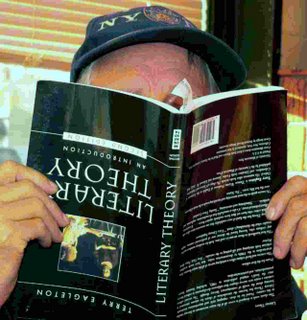
It is NOT A JOKE -- my copy of Terry Eagleton's Literary Theory: An Introduction was bound in its paper wraps upside-down. This coffee klatch regular in our corner restaurant still enjoys me passing books around for his morning read over java.

EAGLETON, TERRY. Literary Theory: An Introduction. Minneapolis: University of Minnesota Press, 1983. Pp. viii + 244


A LINK to a Summary of Lit Theory, An Intro via The French Review 58.4 (1985): 572-573

Il Postino's Noiret loses cancer battle

0 comments

Guardian Unlimited Film

After seeing Cinema Paradiso and one or two other films in which Noiret figured prominently, he became one of my favorite European actors.

See images and filmographie (listed in French today in the Journal de Montreal).

"Philippe Noiret, the French star of Il Postino and one of the greatest actors of his generation, has died after a lengthy battle against cancer. He was 76.

Noiret, the winner of two Cesar Awards for La Vie et Rien D'autre and Le Vieux Fusil, got his big break in the 1960 comedy fantasy Zazie Dans le Metro and went on to star in more than 125 films, including Cinema Paradiso, in which he played a village projectionist. "

25 November 2006

Two Poets, Same Challenge: Rethink Our Public Education System

0 comments

Poets earning a living as professors are legion. But few take an active role in attempts to restructure the educational institution as such. W. B. Yeats was one of the rare 'educationist' poets. Here we touch briefly on two poets In Canada to offer recognition that both have bothered to wear these two hats.

Dennis Lee's role as an educator was part of what I would call utopian experimentation during the wave of counter-cultural upsurge in the 1960s. Since Lee was part of a specific collective movement at the time, let us describe in quotes that revived 'Rochdale' experiment.

Rochdale College
Co-operative housing experiment

Rochdale was the largest co-op residence in North America. Rochdale occupied an 18-story student residence at Bloor St. and Huron St. in Toronto. It was situated on the edges of the University of Toronto campus and near Yorkville, Canada's hippie haven in the 1960s and early 1970s.

Rochdale took its name from Rochdale, a town in north-west England, where the world's first cooperative society was established in the 1800s.

Rochdale College was the largest of more than 300 tuition-free universities in North America, and offered no structured courses, curriculum, exams, degrees, or traditional teaching faculty. It became a hot bed of free thought and radical idealism, in many ways resembling a tribal community.

Traditional professors were replaced by "Resource People" of various academic and non-academic backgrounds, who would lead informal discussion groups on a wide variety of subjects, as opposed to structured classes. A Resource Person of note was author Dennis Lee.

Students had complete freedom to develop their own learning process, much of which emerged from the shared community experience. The college included theatres for drama and film, and a ceramics studio. Students decided school policy and made their own evaluations.

Rochdale students were involved with various cultural institutions in Toronto such as Coach House Press, Theatre Passe Muraille, The Toronto Free Dance Theatre, and House of Anansi Press.

It was typical of the free universities not to award degrees and the University of Toronto did not offer degrees through Rochdale College, but anyone could purchase a B.A. by donating $25 to the college and answering a simple skill-testing question. An M.A. was $50, and the applicant could pick the question. A Ph.D. did not require any skill-testing question, and sold for $100.

The Rochdale application also described its "non-degree": "We are also offering Non-Degrees at comparable rates. A Non-B.A. is $25.00. Course duration is your choice; requirements are simple, we ask that you say something. A Non-M.A. is $50.00 for which we require you to say something logical. A Non-Ph.D. is $100.00; you will be required to say something useful."


Whether you believe that Rochdale was one of the early predictable debacles in 'free' education or not, Dennis Lee came out of the same period as a poet wearing laurels (for a long poem entirely consistent with the Rochdale philosophy). Lee's Civil Elegies and Other Poems was awarded the 1972 Governor General's Award
for Poetry
.

The poem has been reissued by House of Anansi.* You can read a multiple-page excerpt in The New Oxford Book of Canadian Verse in English (1982); the edition Margaret Atwood compiled.

*SEE
Civil Elegies
and Other Poems
64 pages
with French sleeves
ISBN: 0-88784-5576


An interesting and mainstream contrast to the Rochdale experiment in education is the ongoing, provincially funded and academically accredited 'non-experiments' in education (what 99% of the students must live with) within the mortar and brick of Canadian colleges (CEGEPs in Quebec) and major universities. David Solway is a prof in such realworld institutionalized set-up.

Of course, we are taking liberties and a major shortcut when we compare two Canadians educators simply because they happen to be poets and compare activity in education separated by three decades, one utopian, the other state sponsored. Also, Lee and Solway engage with students in different ways and are at liberty to wear one hat at work another while playing and go bare-headed as poets.

I am the one who simply wants to use a series of posts to contrast David Solway's views with what we quoted above about where Dennis Lee intervened (and, in truth, mostly because both are well known as contemporary Canadian poets).

In 1989 Solway authored "Education Lost, Reflections on Contemporary Pedagogic Practice." In 2006 his work "Sweet Poison to the Age's Tooth" brought the same theme up-to-date with a more personalised pitch based on classroom experience at John Abbott College of Montreal. "Sweet Poison" was reviewed in The Antigonish Review # 129 by Wilfred Cude.

Here is a quote within a quote from Cude. (We will take up some of the similarities and differences between what may be called the Lee view and Solway view in upcoming posts).

QUOTE

Education, Solway maintains, "was never meant to be efficient." On the contrary, "it was meant to be difficult, interesting, pleasurable, errant, prodigal in every respect, transgressive, personal, lengthy, demanding, and hospitable - but not efficient." In opposition to prevailing practice, he proposes intensive support for "the only viable scholastic constituency," the one consisting of "students, teachers, and support staff assisted by the necessary minimum of moderately paid administrative personnel."

At the heart of this constituency are dynamic teachers, persons possessing "talent, flexibility, sportiveness, erudition, and a fundamental generosity of the soul," persons capable of "the kind of teaching that can light an emulative flare in the pedagogical darkness of the contemporary classroom." And yet, Solway laments, such persons are precisely those being crushed into irrelevance by a system oblivious to an elemental truth of the enterprise: "there is always something mysterious, something unaccountable in the education of the mind that must be respected and cherished."

Enter the sickenpod, legions of him and her, ruinously funded educational theorists and administrators, bristling with "fixed schedules and ironclad syllabi and straitjacket lesson plans," ardent fetishists every one, proselytizers of "the idol of efficiency." Emanating benign officiousness, they bustle and blunder about, distorting and frustrating everything they profess to enhance. These are the tacticians of our brave new academic world, incessantly questing after measurable results, proliferating endless reams of paperwork to document the latest phantasma of the latest theory, sweeping even the most creative of teachers aside with an avalanche of mindless administrative bumph.

Nothing of this furthers genuine accomplishment in the classroom, and most (if not all) simply gets in the way. "One needs to be absolutely clear about this," Solway protests, crying out in italicized anguish: "neither administration nor technology as such has anything to do with the fundamental learning process." Yet in our system the paperwork keeps coming and coming . . .


Readers interested in David Solway's critique of Canadian poetry and poets should read Director's Cut. (In the essays he critiques nearly two-thirds of the entire English Canadian canon , whether or not the poets are still living! Canada is a young country.

0 comments

Skimming through what Canadian poet David Solway wrote in 1989 about education (ISBN: 0-7744-0330-6), I was picking up bits and pieces about every theory of education right and left going back to Aristotle. It keeps striking me that Solway is on the opposite side compared to Canadian poet Dennis Lee, at least as far as their role and perspectives vis a vis the 1960s is concerned. (We will return to Lee's work on CPE.)

If the rest of Cheap Priceless Editionstill the end of time were but a footnote to Solway versus Lee I think it could still be very interesting and enriching (at least intellectually for me, certainly not financially, and for the readers . . well enough said). Then I would entitle the blog The Hippie versus The Educator: Spurious Time-Frames.

Let's keep that thought, as idiots say, and jump into a Baudelaire poem referenced by Solway as a text 'over analysed' by two heavy academic structuralists.

Solway doesn't say this, but the poem was always free of the shackles of the academics, so why worry? When, however, you stick with your studies and learn, as Solway would have the world turn, you could argue that, after the structuralists did their exigesis, postmodernists broke the bounderies of interpretation of language and liberated Baudelaire to scan freely.

A Link to the Prose at the end, not to the Poem


English translation and French original: Charles Baudelaire (1857)


Baudelaire does not look happy as scholars dissect his poem.


The Cats

Fervent lovers and austere scholars
Both love equally, in their mature season,
Powerful and gentle cats, the pride of the household,
Who, like the former, are easily chilled and, like the latter, sedentary.

Friends of science and fleshly delights,
They seek silence and the horror of the shadows;
Erebus would have made them his funereal chargers,
If they could have bowed their pride to servitude.

When dreaming they strike the noble poses
Of great sphinxes stretched out in the depths of solitude,
Who seem to slumber in a dream without end;

Their fecund loins are full of magical sparks,
And bits of gold, like a fine sand,
Sparkle faintly like stars in their mystical eyes.


-------------------

LES CHATS

Les amoureux fervents et les savants austères
Aiment également, dans leur mûre saison,
Les chats puissants et doux, orgueil de la maison,
Qui comme eux sont frileux et comme eux sédentaires.

Amis de la science et de la volupté,
Ils cherchent le silence et l'horreur des ténèbres;
L'Èrèbe les eût pris pour ses coursiers funèbres,
S'ils pouvaient au servage incliner leur fierté.
Ils prennent en songeant les nobles attitudes
Des grands sphinx allongés au fond des solitudes,
Qui semblent s'endormir dans un rêve sans fin;

Leurs reins féconds sont pleins d'étincelles magiques,
Et des parcelles d'or, ainsi qu'un sable fin,
Ètoilent vaguement leurs prunelles mystiques.


RADI SURDULESCU

Lévi-Strauss and Jakobson’s close analysis of Les chats emphasizes the value of the text as an “absolute object”: this value is due to the complex modulations of its units, be they syntactic, rhetorical or, especially, phonic. [3] In a polemical response to the study of Les chats, [4] the American critic Michael Riffaterre called in question the validity of its authors’ approach, which is based on the delineation of four structures within the sonnet:

1. a tripartite division (quatrain I, quatrain II, sestet), defined by grammatical and metric models;

2. a bipartite division (octet vs. sestet);

3. a chiasma-like division, relating quatrain I to tercet II, and quatrain II to tercet I (in which the cats appear as objects and, respectively, subjects);

4. a system which envisages the sonnet as an open structure, made up of two sestets, separated by a distich.

Riffaterre does not belie the existence of these structures and interplays, but in the chapter “The Irrelevance of Grammar” of his essay he questions their equal contribution to the poetry of the text: not all linguistic symmetries are literarily active in the poem, as a purely “technical” reading may suggest.

Therefore the receiver of the poetic message should also be taken into account, and in that sense Riffaterre coins the term ”superreader”, denoting a fictitious person who should have the advantage of “screening pertinent structures and only pertinent structures”. (38) Riffaterre mentions that the “superreader” in this particular case is composed of:

Baudelaire himself

commentators of the poem, including Jakobson and Lévi-Strauss (when they “deviate from the method”)

a Larousse dictionary, other notes and other informants, and so forth . .

. . thereby he departs from pure structuralism in so far as he takes into consideration also the historical context of the work, and the response of his sensitive reader. However, his celebrated critique of Jakobson’s method is not lacking in arguments: “no grammatical analysis of a poem can give us more than the grammar of the poem”, he contends, and an evenhanded search for contrasts and parallelisms leads nowhere, while it betrays a mere “belief in the intrinsic explanatory worth of purely descriptive terms”.


Looking at structuralism in retrospect, whether in the interpretation of poetry, or in the study of narratives, or in the description of texts in general and of other cultural products, one cannot help observing how far it is, though not very remote in time, from the present-day skepticism towards anything stable and central in whatever kind of textual structure. In a postmodern “quantum universe”, as some thinkers define the contemporary world, a single determinate meaning appears to be impossible to attain, and the binary opposite, with the alleged identity of, and the absolute difference between, terms, is no longer a valid instrument for defining cultural reality, as hard-core structuralists would firmly believe.

Instead, the unstable, self-subverting structures of our post-Einsteinean reality are best described by concepts such as relativity, uncertainty, or discontinuity: the following chapter will deal precisely with this rupture in the evolution of the traditional logic of determinate binary structures.

From RADI SURDULESCU, Form, Structure, and Structuality in Critical Theory

23 November 2006

The Last Opium Den: Grit-Lit Criticism

0 comments

Nick Tosches (author of The Opium Den)
© Anthony Voisin

This short book (a hand-sized hardback with luxury dust jacket) features a writer-as-cynic looking for something long-lost in a macho world. Yet all of us know that some of the best travel essays have been written by men who were androgynous to the point that they eventually underwent a sex-change operation to prove the point. My exception that proves our rule is James Morris who wrote a fine book on Trieste (I won't mention his name again, however, in this post).

I'm setting the scene to run the blurbs for two books on opium smoking. Nick Tosches, six years ago, authored "The Last Opium Den". I just read the book, which is now wider nor taller than my hand. All 74 pages were enjoyable in the same way many articles in the New Yorker, Vanity Fair or Gentleman's Quarterly are diverting and factual. Tosches highly praised the second book whose blub you'll see shortly, Opium Culture by Peter Lee, which I've never looked at.

One thing missing, a sort of contradiction in what I read between the lines and the spin of the Nick Tosche persona : opium is not a woman's sport. Opium is entirely a male thing or it is totally sex-less and a-hedonic. Only the pursuit of the drug, the chase, has testosterone running through it.

An opium den (which is the rarest thing on earth today according to the book) is and always was a filthy hovel where men lie down on little mats cheek by jowel and get dreamy and high on the drug. Yet the author never makes us aware of the male bond, the male environment, nor the subjugation of the women on the periphery of the opium culture. Smoking opium it seems, however, is entirely an escape from women the same way the bar room 'tavern culture' has historically been nearly everywhere in the West.

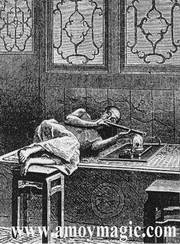
Tosches does, however, suggest that the term 'hip' may trace its roots to the opium den. I do not think he is stretching the point. Imagine the scene of views scores of spaced out smokers all lying down on their sides on the floor. Rising above this sea of a poorly lit bodies, all that sticks above the maze of mats and bodies are their hips. (Sorry this is the only image moment -- send me a link to one if you know of one.)


I think what Tosches leaves unmentioned is interesting because the macho spin of his book blurb suggests to me one of two routes: he is going on a quest -- with or without a core of self discovery. In fact I'm wrong, he may be out for conquest of others, but this seems far from the genre this books is slotted into. On still one more level I guessed wrong again: self identity in the grit-lit genre, as in "The Last Opium Den" is no more, sometimes less, than the persona set up exactly like the blurbs for the author. It is a more literate Marlboro Man. A Jack London or Hemmingway.

The apriori here is 'I'm not a prissy man. Now I'm going on a quest to discover the world. But I won't get all gushy and sentimental about it. I can take my knocks, just as long as I reach MY goal: To Find the Last Opium Den."

At least in a Brechtian lyric I seem to remember, Brecht (maybe it was Kurt Weil) added "Oh, don't ask why (bis) I tell you, I tell you, I tell you we must die." The reason this is pertinent is that in his quest for this opium experience, the author goes to all (all the principal southern) hotspots of both the Kmer Rouge and the Mekong battle zones of 1954 to 1974 and not once does he utter a single phrase about the Vietnam war nor the Pol Pot dictatorship. He hardly mentions civil war in Thailand going on today though he gets shot at when the driver of a motorcycle carrying him decides to run a military roadblock!

Enough said. Don't fret about the plot. The following blurb will give it all away. And I still want to find and read Peter Lee's book despite all these reservations.

Since this is a 'rip' from the publisher, I run the entire press release below about Nick Tosches and The Last Opium Den, complete with the header they provided:

Contact: Yelena Gitlin
Senior Publicist
Bloomsbury
212-674-5151 ext. 617
yelena.gitlin@bloomsburyusa.com

Everyone warns him that opium dens had gone the way of Model Ts and silent movies—relics of a bygone day. That opium, in its pure form, known as chandoo, was a dead drug. Undaunted, and driven by romantic visions of dark brocade curtains, velvet cushions of luxurious decadence, and hushed conversations with exotic concubines mingling with a pungent smoke, Nick Tosches goes in search of the elusive opium den. Traveling from Europe to Hong Kong to Cambodia, Tosches chronicles his quest in THE LAST OPIUM DEN (Bloomsbury, January 8, 2002, $12.95, cloth).

Tosches, a New Yorker, is not concerned by the fact that the last known opium den in Manhattan was raided and shut down in 1957. It was a second-floor tenement on Broome Street, at the northeastern edge of Chinatown, run by the tenant, a Chinese immigrant named Lau. Lau was 57 years old when the joint was raided and was hauled away along with a few old pipes and various paraphernalia, and about 10 ounces of opium. Assured by his sources that even in Asia, the opium dens had all vanished in the last two decades, Tosches still could not, or would not believe it, and left New York in search of the Big Smoke.

Picking his way through alleys where sex, murder, gold, guns or dope can be had for any price, Tosches is unable to find an opium den in Hong Kong. Why? Because there is no such thing. On to Bangkok, where teenage girls can be bought for a night for about four dollars, but still, no smoke. Bangkok, with its vast Chinatown, is said to have boasted the biggest opium den in the world, though not even a trace of the drug remains. In Cambodia, however, Tosches finds enlightenment in a palm frond hut on stilts, in the middle of a swamp, a place that can only be reached via moto. There, he is introduced to the pleasures of the ‘celestial drug.’ Of the experience, Tosches says ‘I am not going to rhapsodize here about opium. But I will say this: it is the perfect drug. There is nothing else like it.’

The smoking of opium, Tosches tells us, dates back to the Bronze Age. Recent archaeological discoveries in Cyprus have brought to light what very well may be opium pipes. Opium smoking was practiced in China in 1500, before that, it was ingested or taken as laudanum; the stuff was introduced to the Chinese by Arab traders in the year 400. The mixture of opium and wine is alluded to in Homer’s Odyssey, and the Greeks not only gave the poppy sap it’s name, but named a city after it (the Doric word for the opium poppy became mekon to the classical Greeks, who gave the town of Kyllene it’s olden name of Mekone. There, in a sanctuary of Aphrodite, an image of the goddess once stood with an apple in one hand, a poppy in the other).

Part travelogue, part history lesson, and part cultural meditation, THE LAST OPIUM DEN is as much an account of spiritual longing and lust of a time past as a quest for a lost drug. Tosches, hailed by the Boston Globe as ‘the grandmaster of grit lit,’ can write about the seedy drug underworld like no one else can, and spins out gorgeous and lucid prose, along with a completely original and unpredictable story.

ABOUT THE AUTHOR:
Born in Newark and schooled in his father’s bar, Nick Tosches is the author of the acclaimed biographies of Dean Martin (Dino), Mafia financier Michele Sindona (Power on Earth), Sonny Liston (The Devil and Sonny Liston), and Jerry Lee Lewis (Hellfire); and of the novels Trinities and Cut Numbers. He is a contributing editor at Vanity Fair.
----------------------------

---------------------- OPIUM CULTURE

Now the other Opium book, the one highly touted by Tosches

BLURB -


In Opium Culture, Peter Lee fills this information gap with a fascinating narrative that covers every aspect in the art and craft of smoking opium. Beginning with a concise and colorful account of opium's history and how it came to be smoked for pleasure in China, Lee then delves into a detailed description of how the poppy is grown and harvested, how the raw sap is refined for smoking, how the exotic inventory of tools and paraphernalia are used to smoke opium the Chinese way, as well as the art and etiquette, the pharmacology and philosophy, and other essential aspects of this traditional Chinese custom. The text is highlighted throughout with interesting quotes by literary luminaries who smoked opium and studded with gems of long forgotten opium arcana.


--- A final remark: neither author connects the dots between the occupation of Afghanistan today and the continuing cultivattion of the poppy. (One caveat being that Lee may have somewhere without the reviewers mentioning the fact).

We can surmise that the opium from Afghanistan is refined not into the opium smoked by Tosches' contacts but goes to make morphine and heroin for the world market. Tosches, to his credit, mentions the Opium Wars waged by Britain against India in the 19th century in their imperialist scramble to monopolize and expand the trade for the greater profit of Great Britain.

22 November 2006

Editor's Epiphany

1 comments

An unpublished writer wants me to read, critique and edit the MSS he thinks should be published. To his mind, it would be ideal that I do this gratis. Yet we have never met, certainly do not share membership in a writers' group and have only been in contact by email.

He knows -- he says it up front in his long, first and sales-man-like message -- that professional editors like to be paid for evaluating a manuscript and writing up an appraisal of publishing potential. What he doesn't seem to realise could fill a book: 1) that we are not literary agents; 2) we don't like to "participate as volunteers" in long-winded sessions as anybody practices a pitch to a publisher-editor; 3) it is distasteful to us to listen to a rant out of the blue against a colleague editor who follows the same code of ethics we subscribe to; 4) when we wear our editor hat we do not diss contemporary published authors, publishers or the entire professional army it takes to put out literary and popular fiction books. (We diss them outside work: as 'private' citizens, like other civilians and on our own time and even on our own blogs, thank you!) Gossip and bad-mouthing are not calling cards we hand out to strangers.


So I am very hesitant to continue any dialogue with any author who understands yet cannot respect the parameters listed above. It seems ever more clear to me that the writer who scrounges down in their first communiqués like I'm his buddy-buddy and share his prejudice against publishers practises is also a writer who is, to all intents and purposes trying to "low-ball me". He probably thinks I'm on my high horse. So knock down the profession and then I will be game to gladly join in his or her 'fun' of 'finally getting into print'. I'll do Mister Unrecognized author yeoman service for little or no monetary compensation.

It is not what's described above that has been an epiphany for me. My eyes have long been open on all these scores after being burned by wannabe authors.

Here is my epiphany: every author worth his salt must be willing to jump through one hoop to get the attention they think they deserve viz -- submit a short sample of his or her prose or poetry.

Wake up. All down the line, every person you are approaching as a writer is someone who will have to 'work' on the text. Maybe his is "only" at the first level of copy flow. Still, it is best to co-operate and help grease the wheels simply because every step aims toward publication and distribution. Repeat: have a sample ready for evaluation for all your initial introductions.

What I realised is that I have nothing against manuscripts over the transom (no one is OBLIGED to read them by deadlines set up by the author -- who becomes a third party to all negotiations by submitting unsolicited). Even here in/at my humble station as line editor, translator structural editor (whatever - sometimes I'm even a literary agent), in other words, from my post at the author's first or second stab at reaching a readership, even moi MUST and am OBLIGED to demand respect for my time by invoking the requirement that said author provide a short sample of writing sans PITCH and without enclosing some winning package of verbose self promotion.

People who approach me with a short pitch get my attention not just because we are playing the old game. They are setting me to work on the next step wherein I describe my services and fees, supply my list of clients as references, and include a resumé. Then the ball is back again in the writer's court. Do you want to set up a meeting? Are you willing to pay me an advance? (You find out who I am, I find out who you are.)

I am far from rigid, yet I detest listening face-to-face or on the phone (or just plowing through an email) where the subject is only about how great a person my interlocator is who is, after all, someone I just met for the first time. Get my attention more agreeably, and I might look over a short sample of your writing. Then we can talk turkey -- what I can do for you.

(Odd though it is. By starting out on the wrong foot, displays of insecurity through needless self-promotion put the editor even more firmly in the drivers seat. That is a shame in a relationship requiring collaboration and mutual respect.)

I honestly dislike asking people to jump through hoops! Nor do I view life as a mere matter of earning a living by hopping and skipping like that. Maybe, I have faced a bad alternative -- the spinning of my tires and an author's in slick mud. My question to writers seeking editorial or agent services (albeit paid services): What are a series of self-congratulatory ads worth as introductions, what sort of communication line are you setting up staying in constant-pitch mode?

21 November 2006

O.J. Jams --- This just in (via) Bookninja

0 comments

November 20, 2006
Simpson Book Cancelled


Murdoch has pulled the plug on the OJ book. No word on whether he's pulling the plug on that walking train-wreck Regan. Her moral sense is on life-support already, perhaps it's time. I'd call it an act of mercy if you canned her, Rupert. You'd be putting her out of our misery.
-- bookninja

BLOG ADDICTS will be browsing on this cancellation of a book title that generated huge quantities of BUZZ.

Prediction:
The editor-publisher Regan (who still has to answer to her boss) will now be scrambling for a new title that will sell even better than O. J. Simpson's post-violent slap at his own 'thang.' Watch for another controversial title pushed by Regan, the publisher who just backed down "under popular pressure".

-----------------------

An articulate editor and skilled writer from Toronto commented:

COMMENT QUOTE
Franklin Carter says:
November 20th, 2006 at 7:49 pm
The Toronto Star sez: “Sales for If I Did It had been strong, but not sensational. It cracked the top 20 of Amazon.com last weekend, but by Monday afternoon, at the time its cancellation was announced, the book had fallen to No. 51.”

So bookstores sold a few copies. I suppose these “rarities” will become collectors’ items. They might still fetch a few bucks on the open market.

I wonder if O.J. autographed any of them . .

END QUOTE

FLUXEUROPA: THE ART AND IDEAS OF WYNDHAM LEWIS

0 comments

Lewis was Anglo-American, Ezra Pound and T S Eliot were American, W B Yeats and James Joyce were Irish and Gaudier-Brzeska was French.


----------------------- From FluxEuropa (which ceased active publication in 2003) thanks to a link picked up at my favorite (this week at least) blogziner site: Spike/Splinter UK
. . . An outline of the significance of the artist and writer, Wyndham Lewis, the leading figure of the artistic and literary movement known as Vorticism.

" PERCY WYNDHAM LEWIS was born in 1882 on a yacht off Nova Scotia of an American father and English mother. This beginning is significant. Lewis was to become a key figure of the English intellectual, artistic and literary avant-garde of the first half of the twentieth century, and few of this talented circle were English. Lewis was Anglo-American, Ezra Pound and T S Eliot were American, W B Yeats and James Joyce were Irish and Gaudier-Brzeska was French.

. . . more . . .


"Vorticist prose, of which Lewis's Nietzschean novel Tarr was the apotheosis, certainly followed Imagism in its verbal economy. It was terse and was characterised by clear visual images. Lewis did not enter, empathetically, into the emotions of his characters, but viewed them externally, as a painter or sculptor."

. . . more . . .

Although Lewis was at times his own worst enemy, his greatest mistake was to write a sympathetic account of German National-Socialism (Hitler, 1931) in which he naively treated Hitler as someone who would bring peace to Europe. He soon rejected this view and later wrote the ironically entitled book, The Jews, Are They Human? (1939), and The Hitler Cult (1939), but the damage to his career had been done.

In 1939 he went to North America (Windsor, Ontario) in the hope of escaping the unpopularity he had gained in England. This merely swapped infamy for anonymity and he was forced to scrape along in a hand-to-mouth existence."

. . . . . . . a note

Blogaulaire (your CPE host here) is reading the literary journal put out in Montreal in the 1950s and realeased as an edited, photo-duped paperback by Vehicle Press in 1983: "CIV /n" (ISBN: 0909890415) Among the original editors of CIV /n, there was quite a bit of support for Ezra Pound, especially from Louis Dudek and Anna Azzulo. Yes, I do see imagist devices in the Montreal group's oeuvre, including Irving Layton's and Leonard Cohen's verse and prose poems. But "Vorticism"? Wouldn't that be hard to define?

We'll be digging around to find that "Tarr" novel . . .

20 November 2006

Pricing Pynchon : Used Not Battered

0 comments

The latest Thomas Pynchon novel Against the Day premieres in new-book bookstores in hardcover today

" . . . three bookstores believe Thomas Pynchon deserves one and are staying open past midnight on Monday, November 20, to sell his first novel in nine years, Against the Day (Penguin Press, $35)."

See:
Trio Plan Midnight Events for Pynchon
by Kevin Howell, PW Daily -- 11/17/2006


Well yours truly has been reading Pynchon over the years, mostly long after the titles became renowned, and wanted to see using the book-search engine AddAll what my solid, Good Condition, 1967 paperback copy of The Crying of Lot 49 ( a mere 138-page pocketbook from Bantam ) could probably fetch if I sold it on the online market. (Put it online at any one of the Mega-Vendor Used Books websites that is, which I won't do however and in any case.)

Below are the search results. (My conclusion is that I could reasonably ask US $16.) This 40-year-old paperback is not hard to find online. For $1, plus 12 times that in shipping costs, you could receive a reprint from the 1970s or 1980s in the mails.)

Our search for "Title: The Crying of Lot 49 ..Author: Pynchon ..Keyword: Bantam .." brought up 41 title(s).


With 16 of them priced below US $ 10.50 (various conditions, year, printing and, as always, a variety of handling and shipping rates (sometimes restricted to within the US).

Our search for "Title: The Crying of Lot 49 ..Author: Pynchon ..Keyword: Bantam, 1967 .." brought up 6 title(s).


Priced from US $10.80 to $28.68 (hence mine is "worth" US $16).

19 November 2006

COCLA in New Digs -- Ville St. Laurent

0 comments

COCLA (Corporation Culturelle Latino-Américaine de l'Amitié) 514 748-0796
NEW ADDRESS: 1357 St. Louis


From de l'Eglise COCLA moved to Rue St. Louis in late October, 2006


The United Church had recently sold the former building that had been home to COCLA for more than two decades.


So COCLA bought this house on Rue St. Louis. The United Church "rents" office space from COCLA in the new place.


Coming by the metro?

DIRECTION: Côte Vertu


Get off one stop before the terminus of the line. Exit at the back of the train (southern end) at Metro du College.


The street is right there, clearly marked just behind the du College exit.


Turn left on St. Louis and COCLA is in the house on your left only a few doors down from the back of the du College entryway on Oimet.


If you see houses like THIS,
you are WAY to the north
probably at the wrong exit
of du College metro station.


Walk back toward the south until you see the new condos and narrow streets BEHIND the subway exits. This is NOT like the old neighbourhod -- but it will still be plenty of fun settling in.


The old gang is still there . . .


Squeezed into our "cocina" a little more tightly . . .


Gone forever (sigh!) the spacious auditorium plus the downstairs activity centre and (Sigh!) that old-style kitchen for serving a dining hall full of friends . . .


And YET, and STILL
COCLA survives to
Serve good meals . . .


Chatting away and joking alot . . and in Spanish, of course . .


And preparing the truck and the "garage" and the storage areas for winter and a full schedule of food distribution, counselling, celebration and everything we lived for before.


The telephone number hasn't changed, so give Roy, Yolanda and Dulio a call and come early every Friday to join "la brigada de lechuga."


La jornada acabó con una comida entre todos los participantes. ...


Many local COCLA activities & celebrations with Greater Montreal's populous Latin community are scheduled throughout 2006 - 2007.

The Festival Latino (held 18 November 2006 to benefit COCLA), plus more to come, was at Le Centre des loisirs de Saint-Laurent, 1375, rue Grenet, in Ville St. Laurent (Montréal).