price-compare results for meta vendor sites

Auth:
Title:
Kywd:

11 January 2007

Press Release: United States Supports Education in Mauritania Continues Campaign to Distribute Books to Schools

0 comments

December 21, 2006
Nouakchott, Mauritania

Ambassador Charles H. Twining, Chargé d’Affaires of the Embassy of the United States in Mauritania and Cheikh Ahmed Ould Sid’Ahmed, Minister of Primary and Secondary Education, presided at a ceremony this morning to mark the donation of books to the Arafat secondary school in Nouakchott. The donation included a collection of over 300 titles in Arabic, French, and English covering subjects such as history, literature, science, economics and finance, computers, health and several others.

The contribution was part of the continuation of a vast campaign against illiteracy that the Embassy of the United States began September 8, 2006 on the occasion of International Literacy Day. The secondary schools of El Mina 2 and Sebkha also received donations at ceremonies involving other officials from both the United States Embassy and the Ministry of Primary and Secondary Education. A planned seventy-six schools in all thirteen regions of Mauritania will receive books under the literacy campaign, which the Embassy is conducting in close collaboration with the Ministry.


This press release "looks" more official on the virtual stationery of the US Embassy, plus you have the public affairs links and access to other background info.


Maybe Sending Books to Africa is Not Just Hot Air . . .


Speaking frankly, in North America, over the next several years, we have millions MORE new and used books that are going to do nothing but sit in warehouses or even damp basements until they are no longer even worth being hauled out and pulped (though pulping could be easily arranged at a profit).

In Europe there are real distribution-to-Africa programs in place -- even tax incentives for modest numbers of titles that get sent at cost or below through several African channels. In a few cases, unfortunately, some of the textbook titles have been ordered and paid for through African ministries of education because the educational publishing infrastructure does not exist locally - - all the editorial and production jobs stay in the Western home headquarters of the Western publishers under such export incentive programs. (Something to think about when we consider 'dumping' our surplus on poor nations.

Whatever the case, 'we', including used book people, own a ton of dead pulp we refuse to release onto our own local markets YET we know this material will never see the light of day or a readers' eyes WHILE the US Embassy is making claims, at least, of supporting 'vast' English-language literacy campaigns in several African nations. Last I heard, the US owns many huge cargo planes as well (though Canada has none).

The Dragon's Almanac 2007 - 11 January

0 comments

senior citizen

from Justin Wintle

"If a person is seventy, do not put him up for the night; if a person is eighty, do not ask him to sit down."

. . (41) Chinese

10 January 2007

JustSeeds needs your help!

0 comments

!
Help save a priceless radical art project from shutting down!

By ryan

For 10 years, JustSeeds has been a critical resource for radical artists working outside the 'art world' system. In the process of becoming a decentralized artist-owned cooperative, the floor suddenly fell out from under them. The collapse of Clamor Magazine leaves JustSeeds without a distributor and in colossal debt. Help save a priceless radical art project from shutting down forever. The community of art-activists around JustSeeds have launched national projects like the Celebrate People's History poster series, Street Art Workers, Drawing Resistance, Cut & Paint, and a hell of a lot more: now they need your help to continue.

Independent Press Association Ceases Operations

0 comments

FROM Infoshop News -

Blogaulaire constantly emphasizes the importance ofdistribution for small press book and nearly all independent publishers: bound books, magazines, zines, tabloids . . . and even art and art posters.

So far, what I have posted about distributors has been negative, bad news. First it was regarding the Chapter 11 filing by AMS (at exactly the same date as this story about IPA broke). THIS - the continuing new NOW is once again bleak news for small press, independent PERIODICAL publishers. (Volunteer contributions and new subscriptions plus direct purchase of imprint titles is what's needed to stop the bleeding, simple as that.)

Pretty soon people will start rummaging around secondhand shops looking for old mimeograph machines and unused stencils. Campus scribes and artists will revive handout culturesof leafleting to get out the copy. I'm only half kidding.

Please read the text blogged below from Infoshop, then click on the titles we've run to read the entire article. Finally, come back to Cheap Priceless Editions, because an entire comment cut 'n' pasted from ChuckO over at Infoshop appears here in italic.

Chuck is the guy who apparently knows how to put this in context better than anyone else.

Blogaulaire is not asking you to use your street sense to figure out what the impact of the AMS-PGW bankruptcy and the IPA closure will mean for New Writing. I'm telling you that many interesting and dedicated people in editorial and production for the words that mean the most are going to have a rough time paying the rent and . . .

Another Distributor for the Independents Goes Under


Wednesday, January 03 2007 @ 09:44 PM PST


Founded in 1996 'to promote and support independent publications dedicated to social justice and a free press', the Independent Press Association (IPA) announced Dec. 27 (two weeks ago) that it was ceasing operations immediately.

Based in San Francisco, IPA's demise follows more than a year of growing concerns about financial mismanagement of the organization's newsstand distribution service which in turn has wreaked havoc on dozens of small, independent publishers. IPA's New York office, which bears no responsibility for the crisis, will also be closing down.


COMMENT QUOTE
Jesus H. Christ! This was totlaly off my radar, although I'd heard about concerns people had about Big Top.

This is really bad news folks. The implosion of the radical press that we saw last month with the demise of Clamor has now turned into a black hole that has taken out IPA and likely a whole slew of radical and progressive magazines. This is going to effect progressive and cultural magazines more than anarchist magazines, but this will probably cause the demise of more than a few magazines and zines.

The SF Weekly article from last June notes that IPA's Big Top distribution project owed magazines around $500,000. That is an amazing shitload of money to owe a bunch of small magazines. That's a half million dollars that small and alternative magazines won't be getting. They won't be able to pay their printers, pay for postage and given that most magazines operate on precarious margins, this will be a disaster.

IPA was a pretty good association, lobbying on behalf of indie magazines. They took on the postal service after the recent rate hikes which fucked over magazines. They took on chain bookstores like Barnes and Noble and Borders, which were screwing over magazines with a "chargeback" scam (the bookstores charged publishers extra money if bar codes didn't scan). The IPA ran several good programs that supported small ethnic presses.

Dear readers, let me try to emphasize how bad these developments are for publishers and why the alternative press is being sucked into a growing black hole.

Small publishers are obviously hurt when any of their distribution networks go under. One of the reasons why the capitalist media maintains its hegemony is because their hugeness makes it possible to control distribution networks. The alternative media has to make do with anything they can to get magazines onto newstands or mail them to subscribers. When distros like Big Top, Clamor's infoShop Direct, Fine Print, Big Top, or Tower go under, magazines don't get paid money. This means they can't pay print bills and other expenses. This lack of cash flow disrupts their publishing schedules, angering readers and creating other headaches. The loss of any distributor is the loss of another scare network resource. The fewer the distributors, the harder it is to get into bookstores. If a distro decides to not carry your periodical, you don't have many options.

When Fine Print when under in the 90s, that really hurt the alternative media, including one anarchist magazine that I know. This past year we've seen the end of Big Top, Clamor, and Tower Records as distros and retail outlets.

The other option for publishers is subscriptions and direct sales to bookstores and events. The postal service keeps raising magazine rates, which hurts indie publishers. Selling direct to infoshops and bookstores is possible, but it is a logistical headache. The reason why magazines rely on distributors is to transfer the distro work to a service so the publisher can focus on publishing the magazine. Selling direct to bookstores and infoshops is a precarious option because fewer bookstores and infoshops are selling periodicals. They also aren't timely and efficient with periodicals, because administering periodical sales is complicated.

Then we can throw in the fact that magazine sales are down across the board. People are reading fewer magazines and zines. Some would point out that alternative websites, podcasts, and new media can take up the slack created by the demise of these magazines. This is a good point to some extent, but it masks several serious problems.

The first problem being that people don't give money to alternative websites like they do to print magazines. People like to exchange money for a tangible product. Online magazines across the board have problems raising money online. Go to any radical or progressive website--Common Dreams, New Standard, Antiwar.com, CounterPunch, Infoshop--you can see that they all have to have frequent online campaigns. Even when I worked for Science magazine, which is the most prestigious science magazine in the U.S. (circulation arounf 150,000), we were constantly worried about the Internet causing financial headaches. I attended more than a few meetings where we brainstormed, argued, discussed, and analyzed how to get people to subscribe to an online version of the magazine.

When these dead tree alternative magazines disappear, it creates new hurdles for online alternative media. We have fewer radical writers, artists, and journalists to draw on. If people don't get exposure through a magazine like LiP or Clamor, they aren't going to be motivated to compete with people for a smaller pool of online alternative media outlets. Many of these small magazines paid their contributors. Many of these contributors will have to turn to other work to earn a living or supplement their income. People complain here all the time about Infoshop News running stories from the mainstream media. I'd love to stick with all radical writers, but it will be harder to find these writers and journalists if print alternative magazines go away.

Isn't there some old saying that if we don't work together we'll hang separately? I'm not sure how that goes, but I'm more comfortable with science fiction metaphors. The black hole that is consuming alternative print magazines won't stop with just dead trees media.

Chuck0

/END COMMENT QUOTE

Creekside Quoting Stephen Dunn

0 comments

In a post at Creekside by T. Jackson, quoting from Stephen Dunn's Riffs & Reciprocities, the bit from Dunn I liked a great deal was this

Best is the extra that comes unencumbered: pure generosity of spirit,
always replenishing itself. We the less generous are quick to suspect it,
remembering what we've given and why. But those who have it irradiate the day.
They redefine the meaning of wealth.

Maybe, as a box-quote out of context on Cheap Priceless Editions, sitting out there naked in the middle of my post, the words read like sloshy sentiment.

But I like the writing, the sentiments. It's the special opposite that is set up by the words below, though, that I can identify with most:
"A grudge is more my style, weeks, months of resentment silently borne. At my worst, after quarrels, I've kept it in and let it mix with any old bitterness it could find. When it finally emerged—stunted, timed, cruelly calm—I was no one's decent man. But I'm seldom at my worst and can only envy the brilliantly angry . . . "

The Dragon's Almanac 2007 - 10 January

0 comments

burning candles

from Justin Wintle

"The stingy man would rather light his finger than a candle."

. . (37) Japanese

09 January 2007

------ Affirmed: Good Mental Hygiene is Not a Handicap in the Used Book Business ------

0 comments

Cheap Priceless Editions proposes to organize a public debate, a sort of open forum circulating city to city, on the proposition stated in the title. We think, given most people's experience with high-profile book people in this business, the premise is most certainly being questioned by ordinary customers.

On the left side of the stage you will find the team of local booksellers arguing in the affirmative, i.e., good mental health in the seller is of no harm to self-survival = the 'Darlings'

On stage right, with microphones though hidden behind a brightly-lit scrim, will be the team (again, all local recruits from among this particular city's more colorful booksellers) arguing that good mental hygiene in a bookseller IS a handicap = the 'Dingbats'

We can just imagine Darlings emphasizing personal grooming, the importance of regularly dusting the straight rows of well organised, rationally grouped books . . . the Dingbats comparing their book operations to Shakespeare & Co. in Paris . . .

After the debate is officially closed and the audience has voted the winner in 'Darlings' versus 'Dingbats' if, and only if, the Dingbats win, will the curtain on the right be withdrawn, and refreshments then served to the audience by the debaters, and the whole gang can party hardy for the rest of the night . . .

But if the 'Darling' booksellers win the audience's vote, Thelma Blunt or some other local librarian will take the stage to explain all about her theme: 'Using the Internet to Access Local Library Services'. As Ms. Blunt speaks, county social service workers, assisted by uniformed officers, will quietly escort 'Dingbat' debaters out the rear exit of the auditorium, and the hall will close by 9:45 pm.

(Hey, if I'm not going to apologise to book dealers for that one, how can you expect me to apologise to all the librarians who read CHEAP PRICELESS EDITIONS?)

Pacific Northwest's Antiquarian Extraordinaire on a Roll on a Grand Blog

0 comments

Michael Lieberman, Antiquarian Bookseller is on a textual, visual (and a couple sound-bitten) rolls at his book blog from Seattle, Washington: Book Patrol. Drop in and check his info-rich uploads out.


Lieberman has my vote with his editorial against Canadian bookbuyers trying to start a boycott of Heather Reisman's Indigo and Chapters bookstores over her support of a charity aimed at Israeli service personnel. Michael offers more interesting parallels to US issues than I could think up to argue against purchaser boycotts as secondary pressure tactic in disputes about whose charity or even whose imperial invasion army gets a bite out of your mega-store spending this or any other year.

After browsing Book Patrol (and viewing Lieberman's YouTube uploads), I'm tempted to find a job touring the world to hold up copies of secondhand books for sale for the video camera-person; each title in front of its own unique and amazing touristic and/or geographically stunning background. The video feeds and MY travel expenses paid for by the book vendors selling online. (Wish me luck landing that job. Again, see his YouTube post for details.)

Thanks to Bibliophile Bullpen for pointers, via the naked desert oasis bookseller YouTube video, to Book Patrol's blog.

Naked Man Bookseller - My Sediments Exactly

0 comments


Thanks to my usual blog affine info transformers in Brooklyn, Seattle and the Bronx and to YouTube for this.

Blogaulaire's ideas and inspiration, generated by all the mental 'pause' this video caused inside my own neural network -- my spontaneous reaction to what this video says about selling books on some desert oasis -- all that is dealt with a couple POSTs above this YouTube box.

Do not hesitate to click on the arrow below the you tube. I've seen posters of Allen Ginsberg that were more revealing than these Book Oasis cameos.

The Dragon's Almanac 2007 - 9 January

0 comments

Scotsman

from Justin Wintle

"It is a plain fellow who neither burns incense nor breaks wind."

. . (34) Japanese

More Info Plus More Comment About a Mindless Murder in New Orleans

1 comments

After Helen Hill, a 36-year-old animator and filmmaker, was murdered in her New Orleans home last Thursday, it was picked up as news by the major mass media in both the US and Canada.

I'm so aggravated and angry,” said Helen Gillet, an experimental cellist who gathered with about two dozen other friends of the couple outside their modest frame house in New Orleans's Faubourg Marigny neighbourhood late yesterday afternoon. “I'm outraged at what's going on in the community.

With the above quote, The Globe & Mail (Toronto, ONT, Canada) ran the story -- about Canadian-Americans: a murdered mother and a seriously injured father and a two-year-old son, Francis, who was unhurt -- by emphasizing his and her Canada connection as well as their activist commitments toward saving the NOLA community post-Katrina:

(Both) family doctor Paul Gailiunas, who grew up in Edmonton and trained in medicine in Halifax (and) Ms. Hill — who was born in the United States but took Canadian citizenship . . . were part of the community of artists, poets and other creative types, refugees from the rest of the United States and elsewhere, who have been drawn to New Orleans because of its singular history and culture. -- emphasis added by Blogaulaire

North of the border, it seems, this sort of story generates more comment on an Internet news website than in Louisiana, where it happened. On the G & M comment thread you find this example of cross-over posting in a 'comment-on-the-news' thread:

Carly MacKay from United States writes: Some of you posters make me sick. This was an article about a horrific tragedy suffered by a Canadian family who came to New Orleans to make a difference. Yet so many turn this into an opportunity to bash every American south of the border. Here is a newsflash, Americans don't think you live in igloos, we know you have electricity, the vast majority of us see the problems we face with a bozo in the White House, 3000 soldiers dead in Iraq, huge gaps between the rich and the middle class and the poor, AND yes for what ever reason Ray Nagin was re-elected in NO. So when one American makes a statement or asks a question like 'Is there electricity in Canada?' don't jump to the conclusion that all Americans are ignorant. Sometimes the only way some people can feel good about themselves is by degrading and insulting others. I wish some of the posters on this comment board had one speck of the intelligence, compassion and understanding that this couple had. I just wish that they had not gone to New Orleans. They will be in my thoughts and prayers. God bless Canada.
Posted 06/01/07 at 10:15 AM EST

Continuing to read the story in the the major mass media coverage from the US:

The Associated Press coverage (picked up by The Times of Shreveport (Louisiana, USA) did not make the Canada connection but gives greater depth to murder victim Helen Hill's cinematographic credits and the medical practise profile of injured physician-husband-father Paul Gailiunas. The Times also added an appeal that anyone with information come forward to help find the criminals responsible:

They had moved to the Faubourg Marigny neighborhood near the French Quarter about a year after Hurricane Katrina wiped out their home in the Mid-City neighborhood.

Police said both were shot at their front door about 5:30 a.m. Thursday. No other details were available. A friend said family members from Columbia, S.C., were on their way to New Orleans on Thursday after learning of the shooting.

“They were wonderful people. Two bright spots in New Orleans. They gave us hope that people could live together. And they’d do anything for anybody,” said Sheri Branch, who was taking care of the couple’s 2-year-old son while Gailiunas was hospitalized.

Hill made short films; her experimental animation shorts had been shown at a number of festivals in the United States and Canada.

She won a $35,000 fellowship in 2004 from the Rockefeller Foundation’s Program for Media Artists for her film “The Florestine Collection.” That film was described by the program as “reflecting on handcrafted work and race in New Orleans, through the personal story of a woman who made hand-sewn dresses.” She also taught filmmaking and animation to grade school through college students, the foundation’s news release said.

A Harvard graduate, she earned her master of fine arts in experimental animation from the California Institute of the Arts in 1995.

Gailiunas, who was in stable condition Thursday, opened a clinic for poor people in the Treme neighborhood in 2004. It was flooded by Katrina a year later.

The state Board of Medical Examiners lists him as working for Excelth Inc., a community-based group providing health care to poor people.

No witnesses to any of the killings has come forward, police said Thursday, begging for help to solve the most recent homicides.

A captioned photo gives the hard news:

New Orleans police investigate a shooting Thursday. Officers arriving on the scene at 5:20 a.m. discovered a man kneeling at the front door holding a 2-year-old boy in his arms. The man had been shot in his right hand, right cheek and left forearm. The boy was not injured. A woman who died at the scene had been shot in the neck. (AP Photo/Bill Haber)

Friends of Helen Hill should go to this Internet address for more information or to participate in local memorial services, which will be organised in various spots across the continent.

A PHOTO IMAGE OF THE GAILIUNAS-HILL FAMILY

Donations in memorium of Hill to Doctors Without Borders (Médecins Sans Frontières) are suggested.

08 January 2007

Americans Still Haunted by the Tragedy of New Orleans 2005, 2006, 2007 and counting . . .

0 comments

Richard Eoin Nash at Soft Skull Press's News Blog HERE . . right while Richard is in the middle of this crisis with AMS declaring bankruptcy and he's one of the PGW publishers left high-and-dry for last quarter's woth of sales . . well Nash (who we now know has suffered personal losses that cannot be undone) . . Nash tries to "put this in perspective" by citing how bad things can be elsewhere.

Nash links to reports on this horrible series of murders in New Orleans -- precisely the police protection issue a member of the National Book Critic's Circle (NBCC) Ken Foster has organised today's protest march around to raise awareness and to improve and increase preventive police measures as the city rebuilds.

The articles are this and this.

Richard Eoin Nash is (now it's was) personal friends of two recent victims reported upon in the Times Picayune articles and Nash has his friends in mind the very same moment that the publishing-distribution earth is sinking under his own house. This is one independent publisher (at Soft Skull) with perspective, calling the NOLA news 'an instance of pure evil at work in the world.'

More power to the people marching with Ken! And thanks, Richard, for reminding us that the entire world does not revolve around books and publishing.

The Advanced Marketing Services Quagmire of Deep Sleaze Flows Back to the 1990s: GalleyCat

2 comments

Blogaulaire takes credit for the title . . .

mediabistro.com: GalleyCat:

"When AMS bought Publishers Group West in 2002, all looked good, as the company reported total sales of $763 million built upon supplying books to wholesalers such as Costco and Sam's Club. In fact, the company had been reporting strong sales for several years. But mere months later, in July 2003, things turned for the worse and the stench grew ever thick. That's because the US Attorney's Office in San Diego launched an investigation into AMS's accounting practices, revealing the company overstated its pre-tax earnings by about 9 percent in fiscal 2001, 10 percent in fiscal 2002 and 19 percent in 2003.

The San Diego Union-Tribune, which was all over the story at the time and as it developed over the course of several years, reported that publishers were deceived - to the tune of millions of dollars - into believing AMS had done various marketing activities to promote their books that it had not. In addition, AMS executives misrepresented the company's actions, according to the SEC, and did so from approximately 1999 through 2003 inclusive. Those strong sales weren't nearly as strong after all."


Publishers Group West does not own all 'its' independent publishers and Advanced Marketing Services does not own PGW. People now are baffled about how then they cannot collect their chips and walk away from one another.

Maybe it has something to do with young publishers being totally in the dark (SOMEBODY kept them there for a long time) about how and where to sell books.

And, in the words of GalleyCat: "No wonder a rogue blog called Radio (Free)PGW has popped up to provide some dark humor in dark times, signing off today's flurry of posts with "from the killing fields of America's publishing industry--good day and good luck." SEE -- Radio Free PGW

Cherchez la femme -- Joan Mitchell

0 comments

Cherchez-la - 'elle' - pour trouver:
Jean-Paul Riopelle, Barney Rosset, or poet Frank O'Hara somewhere in Chicago, New York, Paris or on a St. Lawrence River island upstream from Quebec City . . .


Cut 'n' pastes about artist Joan Mitchell from the sort of rambling art review that Blogaulaire loves the most to quote:


Joan Mitchell: One of the Great Ones


"She was operating from a place that existed before risk-free art, brand image art. She could afford to
take risks."

by John Perreault

On the whole, I consider myself lucky to have met Willem de Kooning, Barnett Newman, Andy Warhol, Robert Smithson and other luminaries.. After reading the catalogue for the Joan Mitchell retrospective at the Whitney, I may be lucky never to have met her.

According to stories now told by critic Michael Brenson (Letters to the Editor, New York Times) and both Linda Nochlin and Jane Livingston (in the Whitney catalogue) she seems to have been mean, nasty, self-centered and usually either drunk or hung-over. On the other hand, poet Frank O'Hara seemed to have liked her, so she could not have been all bad.

. . .

Mitchell became one of the exceptions. I think it helped that at first, unlike Elaine De Kooning and Lee Krasner she was not married to another artist but to Barney Rosset, the founder of the now famous Grove Press.

Grove Press and its magazine The Evergreen Review were the American venues for Thomas Becket and then eventually the Beats and Robbe-Grillet. There's that cultural connection again. But wait. Those were different times. Literature and art were linked, unlike now when art seems to look down on literature because there is little money to be made.


. . .

More interesting is the following: if you did not know the gender of the artist---Joan Miro is a man---would you be able to tell the art was by a woman? Is there anything womanly about the work? If you think women are by nature timid, look again. Or maternal. Or prone to delicacy. There is a certain delicacy to the work but this is not what hits you in the face. Abstract Phillip Guston's are more delicate. There is also equivocation but of a kind that is straight out of Cézanne or de Kooning.


. . .

At a certain point she ran off to live in France. Her second husband Mike Goldberg was history and the French Canadian painter Jean-Paul Riopelle was in tow, at least for awhile. The disadvantages of living in France for an American artist should even now be obvious. You are cut off, no matter how many art magazines you read or trips you make to New York. But it is not so much a matter of being cut off from your friends--friends are more than glad to visit and new friends can be made--you are out of the game. The feedback you get is from housekeepers, studio assistants and beholden guests. Issues become French issues or historical issues; masters to be absorbed, scores to be settled. The advantage: if you are difficult, as Mitchell surely was, distance can keep the artist out of the way of the art. If pressed, I could come up with a list of artists I know who would be better off far, far away.

I was looking forward to the Mitchell exhibition and I was not disappointed.


. . .

A full-page newspaper ad uses the tag: "Raw material. Raw emotion." This sounds like the results of a focus group. It is more important to question the feminist rage thesis proposed by art historian Linda Nochlin in her catalogue essay. I think she is wrong. Nochlin seems stuck in the ‘50s when every drips was supposed to mean deep anxiety about the atomic bomb. Clearly Mitchell was a bad drunk. Why not leave it at that.

Copyright John Perreault 2002
First print publication: NY Arts, September 2002
(emphasis added - Blogaulaire)

The Dragon's Almanac 2007 - 8 January

0 comments

Montreal St. Lawrence Street The Main

from Justin Wintle

"Coarse people leave their door open by an inch; lazy people leave it open by three inches; but only complete idiots leave it wide open."

. . (32) Japanese

Barney Rosset: Oral Overview of Evergreen & Grove. Over Thirty Years: 1950 - 1984

0 comments

One of the many book imprints Publishers Group West represents to the reading world is Grove/Atlantic. PGW owns and/or services many, many formerly independent 'small presses', but Grove, to my mind, stands out as the most independent of the independents that were brought into Publishers Group West after merging into the mainstream to survive the 1990s and beyond.
(See PGW's 'Active Publishers List')

Grove Press had been associated with many experimental writers, especially Europeans. By publishing uncut manuscripts from Henry Miller, among others, Grove explicitly took a course that would end up in courtroom challenges over censorship. Rosset was fighting censorship 'Back East' in Boston before the San Francisco Howl challenge put City Lights Books on the literary map. Reading lit, even watching flics in an arts theatre across the US, was once an act tatamount to 'standing up' for First Amendment rights and prepared a generation of middleclass Northerners and Easterners as easy recruits in the mid-60s for the more engagé struggle for civil rights in the Deep South as the Mississippi Summer became a reality. (But I digress.)

PGW publishers own the copyrights to several historic titles on their backlists, books that are distributed through AMS, who declared bankruptcy two weeks ago.Some of the most interesting authors were first courted by American maverick bookman Rosset in the 1950s. Some titles had expired copyrights already.

Whether or not Rosset could corner a title or not, he was prepared to fight tooth-and-nail to publish Tropic of Cancer, Lady Chatterley's Lover and Naked Lunch between Grove covers. Publicity surrounding struggles in the courts only increased the thirst of readers for Grove's books. Book buyers were crawling out from under the weight of Officially Puritanical cultural control. The 50s zeitgeist that lingered as cultural rebellion helped keep Rosset and Grove afloat and independent for over 30 years.

Whatever it is that makes a fiction manuscript 'experimental' is impossible to define, even for the limited number of authors published by Grove. Toward the end of this interview, you'll hear Barney Rosset admit that J. R. R. Tolkien was too wild for this same guy who had published Naked Lunch.

From "Wired for Books"

Audio Interview with Barney Rosset

The controversial editor, Barney Rosset, talks with Don Swaim in this 1984 interview about his acquisition of Grove Press in the 1950's, which he transformed into the most innovative, alternative book presses of the time. He lists the scores of esteemed authors his company garnered and discusses the censorship lawsuits he fought. Barney Rosset introduced Americans to writers such as Beckett, Ionesco, Harold Pinter and Jean Genet.

To listen to the Barney Rosset interview with Don Swaim, 1984
(29 min. 43 sec.)
on -- RealPlayer
-- click below:
Stream: RAM File

07 January 2007

The Dragon's Almanac 2007 - 7 January

0 comments

Queues de Castor

from Justin Wintle

"It is better to make the man wait for his soup than make the soup wait for the man."

. . (28) Chinese

06 January 2007

Scrivener's Error

0 comments

Scrivener's Error: "A Bankrupt System
23:08 [GMT-6]

Last Friday, Advanced Marketing Services, Inc. declared bankruptcy in the District of Delaware (No. 06–11480). AMS is/was the parent of Publisher's Group West, the third-largest distributor of trade fiction (and, depending on how one measures, the third- or fourth-largest distributor of printed books). This is one of the first visible dominoes to fall that will have a significant effect on the publishing industry.

. . .

(If the publishing industry is as unprofitable as it constantly whinges, why do venture capitalists and the like — not famed for their pollyannish views — continue to acquire publishers?) One of those secrets is the distribution system. Since a massive consolidation during the 1990s (when the Department of Justice and Federal Trade Commission were still dominated by Reagan/Bush I supervisors), there have been very few distributors of printed books in the US.
. . .
The most coherent market definition of distributed books is "trade fiction." And the concentration there is astounding: the HHI2 is — depending upon the accuracy of the numbers — somewhere between 1700 and 2400. The two biggest players — Ingram, and Baker & Taylor — appear to have just over 60% of the dollar-value market share in distributing trade fiction.

2 The Hirschman-Herfindahl Index is a measure of concentration in a market. One states the market share of each of the top five market participants as a number out of 100, squares the individual results, and then adds the squares. An HHI of over 1800, under Department of Justice guidelines, indicates a concentrated market, and mergers and acquisitions under those circumstances are supposed to get "heightened scrutiny" if they increase the HHI by a further 100 points. That does not necessarily mean they will be rejected; the burden is on the market player(s) involved to show that in that particular market, any increase in the HHI will not have anticompetitive effects.


Further links to the story:

Advanced Marketing Services, Inc.
(Public, OTC:MKTS) Over the Counter; Symbol = MKTS

To follow the story using Google collection of bare bones background plus constantly updated links, go HERE.

CRITICAL MASS - the National Book Critics Circle Awards blog - advises its readers (particularly all those 'former' freelance writer-reviewers for Advanced Marketing Services, Inc's book review magazine) to check out GalleyCat's coverage . . HERE . . and . . HERE

Book distribution company (AMS) files for bankruptcy. Losses huge.

0 comments

from | Dear Author.Com |


Advanced Marketing Services, Inc is a book distributor to warehouse clubs, speciality retailers, e-commerce companies, and bookstores.

The Group provides product selection advice, specialized merchandising and product development services, distribution and handling services to membership warehouse clubs.
Via Business.com

This morning, Publisher’s Weekly reported that AMS is filing for a Chapter 11 restructuring. Chapter 11 allows the business to basically refinance its debts by either discharging them (which means that the company doesn’t have to repay the debt) or restructuring the debt. It’s debts owed are meaningful:
Random House, which is owed $43.3 million

Simon & Schuster, Penguin and Hachette Book Group are all owed more than $20 million each. HarperCollins is owed $18 million.


Note: I would have pointed to Quill & Quire (in Canada) for discussion of the threat this poses to Raincoast Books (of British Columbia), but Q & Q requires readers pay for a subscription before reading what they posted. (Go to the library for the hardcopy in a month. Phsst on that requirement.)

Raincoast is partly owned by the defunct AMS.

Walking Turcot Yards -- Flying in This View

0 comments

Walking Turcot Yards:

At the image-rich photo website you reach by clicking on the linked title, Blogaulaire's colleagues remark that an aerial photo looking east across the Turcot Yards is about the best overall image you will ever see of the entire site. I am certainly impressed.

Some day, all of the documenting and imaging we see on W.T.Y. will become a book, maybe even a documentary movie. That has not happened yet, so you are invited to see the groundwork toward documenting this and many other urban, forgotten or neglected, open spaces from around the globe.

Remarking on the remarkable shot from an airplane:

"The length of Turcot is somewhat compressed here. For anyone who is interested it takes about 40 minutes to walk from the Turcot Interchange in the backgrouind to the Angrignon Overpass in the foreground, providing you don’t stop to check anything out."

The Dragon's Almanac 2007 - 6 January

0 comments

Wild Rat

from Justin Wintle
"The barn rat has more grain than he can possibly eat; but what does the plough ox have?"
. . (23) Chinese

05 January 2007

If a Book Was Worth the Same Price to Everyone, Poor People Would All Stay Illiterate

0 comments

What a title for a post! I sometimes surprise myself.

You could declare exactly the opposite: if the value of a book were the same for everyone, all the rich people would stay illiterate.

If you have not caught my drift yet, I am taking a stab at some of the contradictions regarding the buying and selling of books.

You must admit that in many industrialised countries there are outlets for used books that are sold at such low prices that even the poorest resident can afford to purchase a few. With a little effort, reading material in such developed countries can be procured free of charge, in a public library if nowhere else. Yet here in Canada, when I give a poor person a book or magazine with something of specific interest to them, they act as if I were a magician or a saint. At least regarding that one little gift. People rarely ask me how they themselves could find such material on their own for little or no expense.

Today I gave away Spanish editions of two Readers Digests (Selecciones) to a couple people from two different Latin American countries. Each issue cost me 29 cents. But if a third party came along before either one of these individuals had finished reading the article about their homeland in the issue I had given them and then offered to buy it from them for 29 cents . . or even $2 . . the 'buyer' would be turned down, and the offer would be refused, I am certain. So the copy of Selecciones is now worth, say, $4 or $10 to the person who has little money but who values the copy of this magazine for its particular content (and the presumed scarcity, i.e, the cost of replacing an article that interests them).

There is an element of the commerce in reading matter (like the booktrade), something about this sample of the buying and selling of hardcopy information, that is antithetical to 'The Education of the Masses' regardless of 'Income Status'. Everyone knows this is true.

In the 19th century, the dime novel came into existence because several technologies were marshaled to make it possible for publishers to make a profit in the book business while lowering costs -- so low that it resulted in almost universal accessibility to reading matter for the British and American people. And people gobbled up the reading material very swiftly all across the industrialised world as this lifestyle expanded.

I, as a beneficiary of this lifestyle, have also lived in another world, despite the fact that I am as middleclass and as insular as you might imagine anyone.

I have lived in a world of constant bombardment by information, most of which was in sound and image without regard to the printed word per se. Much of what I 'learn' is by hearing and seeing messages and it would be simple as pie to become functionally illiterate regarding 'print' and still get by as a functionally adequate citizen of my community - by sight and sound as it were.

The fact that a large percent of any given Western population IS functionally illiterate is a big challenge to the booksellers among us. Booksellers are, in fact, selling to a minority of our populations. (Sometimes, however, we focus on an even smaller minority within a larger minority: divisions within divisions.)

We could become advocates for 'popular' education and go out door-to-door handing out things to read that are targeted toward specific groups, even toward specific individuals within subgroups . . . We could do a whole host of nice things to improve everybody's quality of life and ability to make informed decisions. (As pie-in-the-sky as you want.)

But we don't do all this activist stuff for a whole host of self-interested reasons. One reason might be that we are pessimistic and defeatist about our chances of competing against television, satellite FM radio and oral communication generally, the sort of communications that interrupt anyone and everyone who tries to stand back and just think or who is trying to read what has been written. Maybe we are habituated with isolating ourselves from the rest of humanity just so that we can engage in reading without being interrupted by all the 'noise' in the agora, the marketplace.

Well the irony for all the lonely (REAL) readers is (for the REAL literati) . . the irony for both the elite and for the masses is that the marketplace is having its revenge. Maybe, in future posts on Cheap Priceless Editions, I can think up some convincing metaphor(s) for how mistaken Bogaulaire has been about how the world of books is actually working today.

Anyone who saw the movie 'The Name of the Rose' or who has read Umberto Ecco should understand where I am coming from by flaunting the oxymoron 'Cheap Priceless Editions'. There is a contrast and contradiction in such word associations as 'rare book' , that is, if we are discussing a book printed on a mechanical press. Rare 'printed book' is an oxymoron by definition. A mass-produced book is rare only relative to the demand for the title, relative to the number of books printed, or relative to the book's survival through time in a particular condition. If the content (what is IN the book) is still 'in demand' and if the supply of the book is limited, we have a rare book that is marketable as such. What this amounts to is that the seller who wants to increase his or her price seeks a market where demand is high and supply is limited. (In contemporary publishing, it is only price that is 'fixed' using market'ing' restrictions; demand and supply are maximized

The grand irony (or one of them) is that despite today's high prices for new books, the real democratic forces historically, the forces that worked toward an expansion of literacy, were not the rare book dealers in whose interest a restriction of supply would work wonders, but the real 'democrats' are the forces who work constantly to increase both demand and supply - to wit: publishers. Publishers are in one of the only professions that stands to profit by supplying the most books for the largest market. (Corollary fact: without public education and public libraries, publishers become their own rare book dealers; note the history of luxury, limited and signed editions, especially in European countries and among 'artistes' in North America.)

In a sense, many of the 'rare' bookdealers dealing in the used (secondhand) market are like pilot fish living off the rich. They have adopted what they presume are the elitist attitudes of their patrons. (Even the dealers caught stealing from rare book depositories adopted this elitist posture.)These booksellers buy their supply from their rich patrons, who sell at a fraction of what a rich person pays for an original title. This fact is nearly self-evident. But any dealer buying his or her 'stock' from the Masses of book readers (in the mass market) is not much of a rare bookdealer, because the Masses are reading mass market, mass produced, printed material. These folks (the majority of dealers online today) are in a game of winnowing through millions of books, frantically trying to sort out the 'sports' which for one reason or another are harder to find in the marketplace of books. That takes a great investment of time, space, and energy . . plus total dedication to the process and the book trade. It also implies and imposes low margins.

But at the end of the day, to whom are 'rare books' sold? Bite my ass. I cannot answer that question. If I could, I'd probably be selling off all my own stock in books! Of course, the answer differs depending on the title. But, again, at the end of the day, it certainly looks like an attempt, on everybody's part, to reconstruct a medieval system of patronage, i.e., the relation between rich patron and dependent artisan.

So we have come full circle back again in terms of the contradictions inherent in the book trade, at least in terms of the used book trade -- with all the used-book dealers attempting to turn their collections of 'sows ears' into 'silk purses' by turning mass produced books into collectors' items worth premium prices: not exactly 'cheap priceless editions'.

But I keep being drawn back to what I sincerely believe are the FACTS. Given the fiscal, the tax-related realities of publishing, there is the real danger that many worthwhile, backlisted book titles will dry up and disappear from the marketplace, titles by authors a notch or two below the status of a, say, Charles Dickens to mention an English-language author. And I see the tens of thousands of dealers attempting to sell books on the meta-vendor sites as a deposit library for such titles: as a reserve army ready to flood the market with worthwhile books should publishers fail to meet the demand generated by public education.

Bogaulaire never claimed to be clear about what is happening vis a vis the book trade, especially nothing more than unclear about his own comprehension regarding the book trade's current manifestations. Tentatively, I will say that I hope that booksellers by and large will continue to put the accent upon the positive, upon the quality, and not the rarity, of what they offer for sale in the agora. At least in the book blogs, if not on the vendors' sites, this is what I think is coming down at present.

Table-Top Images of Books Referenced by CPE Recently

0 comments

Yesterday, I posted here about buying sheer, white curtain material.

Things are starting to 'fall into place'. (See images below.)

As I experiment with in my set-up for imaging the reading material displayed on Cheap Priceless Editions, I am noticing many positive differences with less wasted effort in the preparation before snapping the shutter.

There will be little mention, from now on, of the equipment or the arrangements . My reasoning is that you could just as easily be using a flatbed scanner and your own imagination to achieve better results than me.

Using photo-editing software to stitch and combine images is worth exploring. Even (Especially!) my daughters have more skill at using Adobe PhotoShop and other image-editing software than I have. What I do do for imaging is to adapt a few emulsion film techniques I learned as a photo student and studio assistant.

I am adapting these techniques to the wider latitude and greater speed that digital equipment affords. I am being totally opportunistic in taking the benefits and casting off the old constraints of the darkroom. In many ways, once a photographer has a basic set-up, knows his distances and exposures, most of the rest of his or her bag of tricks involves practice and shortcuts and the application of down-and-dirty compromises to avoid fussy fiddling around with all the variables that can so rapidly get out of control and mess up a day of 'shooting film.'

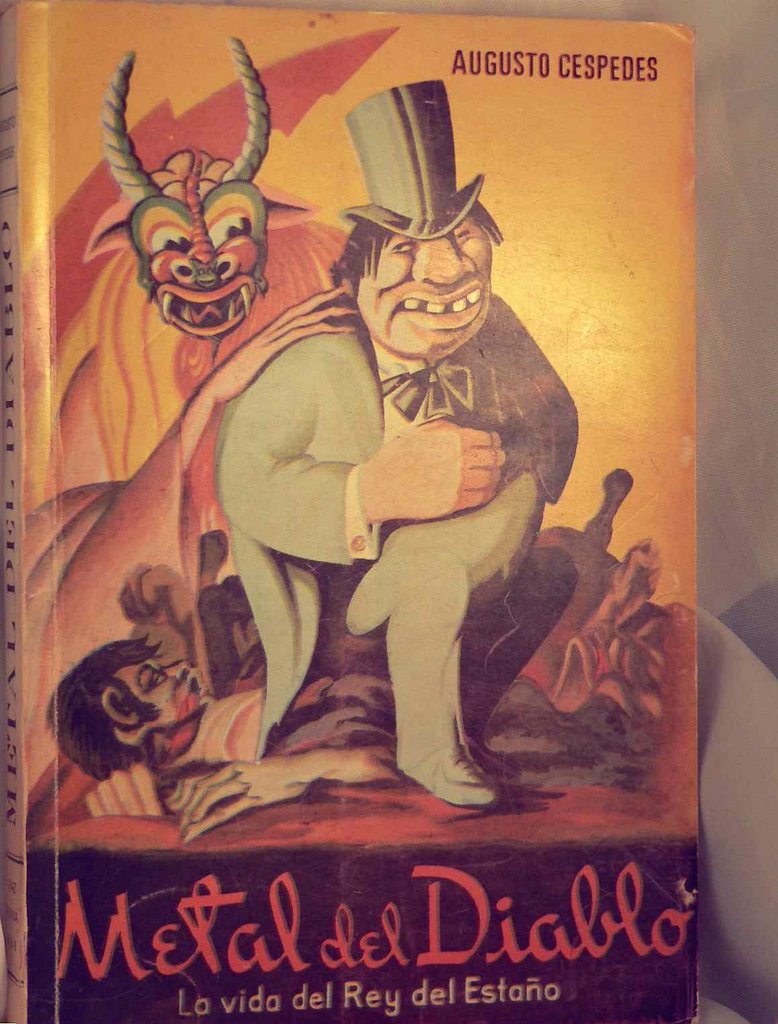
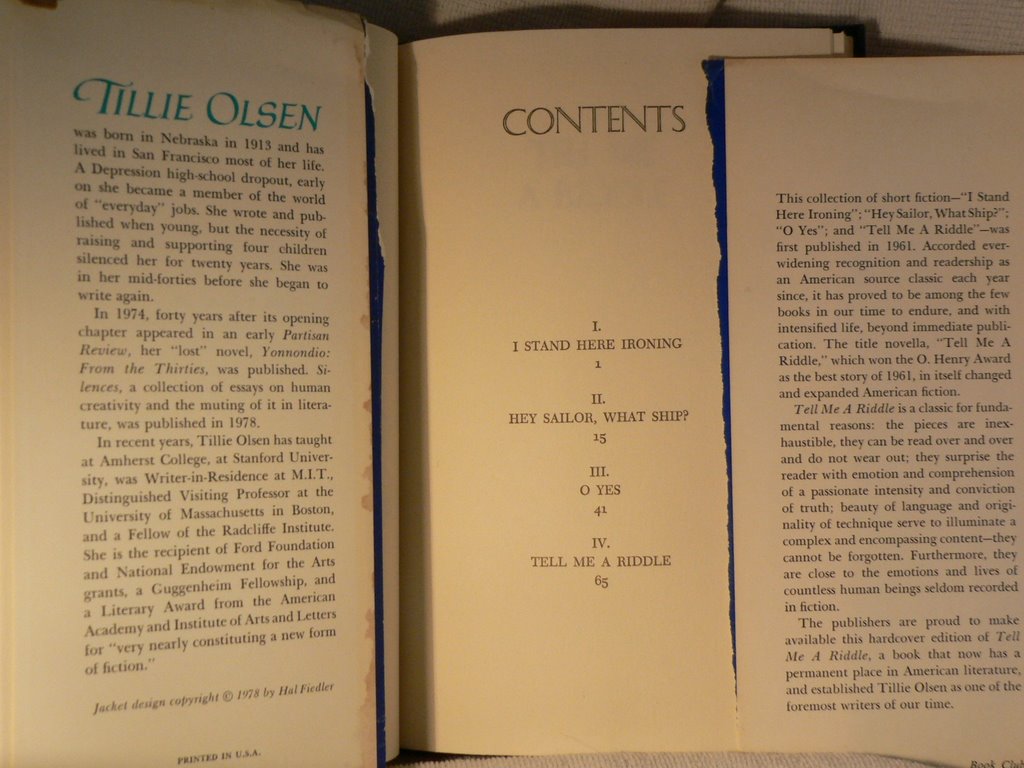
Here are two books that Blogaulaire has used or acquired and mentioned in recent posts:

----------------------------------------------------------------- 1 of 2 images

-----------------------------------------------------------------

This literary and political biography includes many references to Tillie Olsen.

The original Univ. of Illinois Press, 1994 edition would have cost me $50 new. I bought the book through the Internet before I had even heard of the Advanced Book Exchange or any other meta-vendor sites offering used books for sale.

Amazed, today, I cannot fathom how I figured out how to order the damn thing without using a 'bookfinder' vendor website to order it.

(You should stay in touch with your customers; if the bookseller who sent me this Wixson title had written back by email to stay in touch with me, I would have sent more business his way at the drop of a hat.


----------------------------------------------------------------- NEXT IMAGE
2 of 2 images


This is the Cespedes book, the one given to me gratis at the Spanish market after I showed the owner a book of poems by Amado Nervo . . . which I also got that day for a song in a friperie.

I'll be shopping more frequently in that Spanish market, that's for certain!

----------------------------------------------------------------- /the end.


The Dragon's Almanac 2007 - 5 January

0 comments

scanner collage

from Justin Wintle
"Women have twice the appetite of men, four times the intelligence, and eight times as many desires."

. . (20) Burmese
(c)Maggie Taylor

04 January 2007

Talk About Being a Klutz - I Must Be One Too !

0 comments

Random Thoughts


I cut up today to just enjoy today's Montréal version of our own episodic 'winter of globalwarming discontent'. It ended up being an 11-hour jaunt from my breakfast venue, where they hadn't even turned on the lights yet when I arrived at 7:00 am, and then a bus-metro ride up past Jean Talon Market, past Little Italy, to pick up cheap books at my favorite friperie. Finally (though it must have amounted to 6 or 7 hours of a slow saunter south through the Plateau Mont Royal), I made my way down The Main on my return trip by foot.

Along the way I read some interesting books, including a broadsheet by Stéphane Mallarmé in a deluxe edition. So, from a literary standpoint, my day wasn't entirely wasted.

Everywhere I went, books fell on the floor around me. Except in the funeral parlour, thank God'. . . "Funeral parlour!" I know you're asking, but be patient, we'll get there.

At the friperie I picked up sheer polyester material to use as a backdrop and as a diffusion screen for my photo lightbox ($4.00 worth = two French-gathered full-length curtains). I also buy $8.00 worth of secondhand books, including titles that ALL local undergrads are always shopping for - things like Hernann Hesse, Virginia Woolf, a 'gender studies' title or two, et cetera -- Hell, I don't remember all of the titles: it's stuff I have coming out the yazoo anyway. Stuff that I buy to trade-off. (Though I love both authors - don't get me wrong.)

PLUS I discovered and buy (included in the $8 price-tag) what I dearly strive to collect wherever I can. This includes today's "Le Passager", by Gilbert La Rocque (Montréal: Québec-Amérique, 1984) and "jimmy', by Jacques Poulin (Montréal: Éditions du jour, 1969). Both are what I call cheap priceless editions, quoi? I'll blog both titles sometime soon, including photos of the covers.

Another klutz thing I did: I immediately, upon leaving the place, imagine that I have lost my wallet in the secondhand junk emporium (friperie) I've just left. That somebody has picked my pocket. So I go back and raise a stink and get everybody on-edge. Then I reach in my backpack to discover that I had placed my wallet in the same bag as the books - wrapped inside the curtain material. Well, everybody at the friperie was as relieved as I was at that final dénoument to me being a klutz.

So where do I end up next? After walking around Jean Talon and its juncture with Boulevard St. Laurent to get my bearings, I head south. And end up in a friggin funeral parlour, that's where!

I see this sign that advertises a 'café-bibliotheque-bookstore' thingy; a sort of bookish café. That's my bag: arts cafés that sell books. So I go in. But, despite the artsy aspect of the place, it turns out to be a friggin real funeral parlour! Toute la patente. The real thing. I ask, naturally, and they tell me that the café is upstairs, above the salon where bodies are 'exposed'.

So I go upstairs. All the friggin books are about how to deal with mourning - le deuil. Or religion; or . . get this: tons of poetry. By poets I love. Stéphane Mallarmé is there in 'luxury editions'. This, my friend, is a funeral parlour like no other you have ever, ever seen. This is Art in the service of Death, or, if not Death per se, in the service of taking as many dollars from the folks left mourning a loved one as is possible by selling them Art and Poetry to carry them through their sorrows! It is a restaurant attached to a funeral parlour. Both are immaculately up-scale and, as they say, branchés (translation: 'hip').

Am I indignant? No. Am I flabbergasted? Yes. Do I know what to think about it? No.

I was not born yesterday; or, in French, dans la dernière pluie. Urgel Bourgie, the chain of funeral parours by far the best known in Montréal, can afford to set up both an Art Gallery and a café-bookstore for select clients; it is 'On The Main' in Montréal. Do you have such a thing in your community? Where the 'Art' sells for +$1,000 and galley folios of famous poems for over $60 ? Well bite my ass! In Australia, Massachusetts, in Maine and the U.K., in France and in Des Moines you all have such high class, literary and hip funeral parlors? Bite my ass double-time! (Kurt Vonnegut, (remember his Iowa City days?) once imagined this industry of 'cool' dying in a novel. Sorry I mentioned it.)

So from there I saunter down St. Lawrence Street, down toward haunts with which I feel inordinately more familiar. (I did not pop $60 for the Mallarmé poem nor any 'lesser amounts' for all the religious, esoteric, or the 'dealing with loss' pop lit that Urgel Bougie offers for sale in their café .. er funeral home . . er . . WHATEVER. (If I had the money though . . Urgel Bourgie would have made another pile of dough!)

What I did 'pop into', eventually, was a familiar secondhand, used bookstore further on down the line. (I know the owner and his cat.) Here, at W's bookstore, I lounged around with a little less trepidation than in the funeral parlour cum lit-café. After discovering what I wanted as book "purchases", including two books by Tillie Olsen and a novel I'd ignored the existence of = "By the Sound" by Edward Dorn, in a Black Sparrow Press edition,

I end up trading off what I had found in the friperie for what I REALLY wanted to buy, but could not otherwise afford.

You could say that already I am ahead of the game. And despite the unusually warm weather and fact that our entire planet is going to hell in a handbasket.

I, at least in the imagination of one day, stay on top of the game. (Do I feel guilty a bit? ùyes. This could be my last hoorah. Who knows anything, with this globally warm weather? I don't. Nobody around Québec knows what to make of the weather . . what to make of this bizaare winter in Canada. Does Urgel Bourgie) the funeral director?

But 'yet and still' your entrepid reporter has more territory to conquer. I drop into a Spanish books-groceries-kitchen-utensils store on The Main and shop the literature in Spanish. Through some fluke, some misunderstanding about how to translate the word 'listado', the owner-clerk gives away (she actually says 'take it') the Augusto Cespedes title "Metal del Diablo: La Vida de Rey del Estano" after I show her my (recently acquired at the friperie) copy of "Antologia Poetica" by Amado Nervo. I'm not complaining, though I do suspect I've just now engaged in some weird form of shoplifting. Aided by my weak mastery of Spanish.

So all-in-all I'm a happy camper, a successful player of hooky, today. Maybe I have a stack of books that nobody would buy if I decide to offer them for sale on the Internet. (I doubt that, though.) I go home happy. And enlightened about books, poetry and about Montréal as our town evolves.

I do have second thoughts about poetry, about what I like, and about the industry of death that is so profitable. Maybe I should go into another line of work.


03 January 2007

0 comments

Sinn Fein Protest Sale of 1916 Memorabelia

Ireland's National Museum was bidding for items unique to that nation's history of rebellion against British rule. (How such items ended up in private hands in the first place is not reported on this short video newsclip, but this sort of thing is a common occurence globally.)

No need to say much more than what's on the v.o. for the video. Sinn Fein protesters, both inside the auction room and out on the street mounted a vigourous protest. After arrests, the persons detained were released.

Thanks to MyFineBooks blog - http://blog.myfinebooks.com - for calling our attention to this book-related news item.

Tillie Olsen, author of 'Tell Me a Riddle,' dies at age 94

0 comments

AP Wire | 01/02/2007 |

"I'm trying to get used to the idea of a world without Tillie Olsen," Feminist Press publisher Florence Howe said Tuesday. "She gave me `Life in the Iron Mills' in our first year, when we thought we were going to do biographies and children's books. She changed the whole direction of our press. I had never heard of some of the books she was telling me about."


Olsen did little writing in recent years, but she remained an activist. She participated in a protest against a local retailer, demanding better wages for employees. She also joined the fight in the mid-1990s to stop the San Francisco Public Library from cutting support of books in favor of computers.

"She was remarkable, right to the end," Howe said. "In her last days in the hospital, she would walk around carrying a volume of Emily Dickinson. Tillie's memory was gone by then, but she would read the book aloud, from cover to cover, without missing a beat."

A native of Omaha, Neb., Olsen was the second of seven children of Russian Jewish immigrants. Her father, Samuel Lerner, was a farmer, factory worker and paper hanger and an official in the Nebraska socialist party. While some reference works listed Olsen's year of birth as 1913, Laurie Olsen said her mother was born a year earlier.

Educated in the "school of literature," Tillie Olsen never went to college. By age 18, she had joined the Young Communist League and by her mid-20s she had moved to San Francisco and married fellow activist Jack Olsen, who died in 1989. They had four daughters.


Thanks to j. godsey at The Bibliophile Bullpen for pointing C.P.E. to this news item.

'One Tree Hill' gives High Marks to Yours Truly - CPE

0 comments

Thank you 'One Tree Hill' for rating 'Cheap Priceless Editions' as a 'Good Pick' for the Boxxet RSS feed.

It was my Christmas Day post here on Cheap Priceless Editions that rated these high distinctions:

Only a Madman (woman) Never Thinks of Those Less Fortunate -- by Blogaulaire

(If there is a Unitarian minister reading this who would like to use the content for the 2007 Christmas service, I'll try to set up a direct deposit line to my bank account so you can buy it. It will only cost 20% of the collection plate, so we certainly are talking small change here . . :) )

Here, on Cheap Priceless Editions you can go directly ("Do Not Pass O.T.H.") to the same post by clicking HERE.

Blogaulaire knows about RSS feeds, I used to gorge myself on them in another life. But how in hell I would know who reads this blog by automatic feed versus by actually landing on the URL . . well that escapes me. I think it was jgodsey at BIBLIOPHILE who stated that Google Resources offers a tool to keep track but I'll let it ride for now. Feel free to comment if you know more about such monitoring and recommend that bloggers keep track of who reads and who feeds.

(Nota bene: My family comes from a territory close to 'Lone Tree' and my genealogic associations have a more hardtack, gritty side than One Tree Hill's take on such features of the landscape. Seems there were horse thieves operating around Lone Tree where my folks hail from -- that was where they were strung up if they got caught!)

My Mind Freely-Associating with Flashes of Susan Sontag

0 comments

As I age I recognise more and more my weaknesses (and strengths) in spelling. Is there a double 'mm' in 'accomodations', two 's'es but one 'L' in 'succesfull'? So I use a dictionary more often, not less, as time wears on.

Being an editor and a translator, there are many, many print-on-paper dictionaries right here at my fingertips as we speak.

Here is a word I didn't look up: 'mneumonics'. Did I get it right? Using what something sounds like, rhymes with, or memorizing a little jingle and verse to jog the memory; is that right as well? I need mneumonics I guess.

I think of a whole host of things when I'm reminded of the late New York City writer Susan Sontag. But most I think of the military-medical metaphor: winning the 'war' on cancer, that sort of image. Pathogens as invaders that evade the host's defense perimeter.

Well I was just this instant reminded of Susan Sontag in a bizarre manner. (I had to look up bizzare in Webster's BTW.)

I thought of Sontag when I grabbed a big blue dictionary to spell 'accommodation'. By mistake, I grabbed Mosby's Medical & Nursing Dictionary instead of my copy of the Nelson Canadian Dictionary. For about 3 seconds, I kept turning the damn dictionary around, certain that my eyes couldn't focus because I was holding the right reference work only holding it upside down; that is, until after 3 secs I figured out my mistake and then grabbed the right reference work.

It strikes me that so much of what I read on blogs and on webpages is like those confused three seconds. It takes me more than an instant to figure out what, exactly, I'm looking at as I browse the blogs: all because, as they say in French, 'I grabbed the stick by the wrong end' (J'ai pris l'affaire par le mauvais bout.).

Blogging is quite different from participating in a discussion forum, although both activities can be a matter of adapting to several personas. Participants are presenting roles in public. But landing on a blog, it is easy to become confused as to which public this particular blogger wants to direct his or her message and whether you are or want to become a part of that public. (I know, that's what blogrolls and links to bloggers are all about.)

Back to Susan Sontag. I just pulled her out of a hat. Then I pulled one image, a constellation of metaphors out of a hat. Finally, I pulled a French expression out of a hat. Am I trying to connect with people like me who can connect with all three rabbits I pulled out of three different hats, or am I trying to impress people, or, finally, is this a public service being provided in the same way a reference librarian provides a service? I imagine that in a discussion forum composed of reference librarians my persona could comfortably fit into all three roles. But I continually scratch my head wondering about blogs, especially younger blogs like Cheap Priceless Editions where there are no pertinent prerequisites for viewers nor for participants.

Does anyone have a nifty metaphor that is nicer than the military medical metaphor Susan Sontag exposed? Are we playing at the beach and writing in the sand at the wave's edge?

The Dragon's Almanac 2007 - 3 January

0 comments

tabby cat

from Justin Wintle
"When rats invade the castle a lame cat is better than a swift horse."

. . . (10) Chinese

02 January 2007

Carolyn Burke's Biography of Mina Loy - Jacket # 5

0 comments

You can read more about Mina Loy in Jacket #5.

Part One of 'Cheap Priceless Editions' Summer Reading Picks for the Southern Hemisphere . . . (While the rest of us curl up under blankets an freeze . . .)

CLICK HERE

TEASER -- quoted from JACKET 5
For us, decades later, her name opens the door to an era of spirited exchanges between American and Continental vanguards. It conjures up smoky art classes in prewar Montparnasse, costume balls at Mabel Dodge's Florentine villa, Futurist soirées where enraged audiences hurl vegetables at the stage, Dadaesque poetry readings, gossipy visits with Gertrude Stein and Alice B. Toklas, dinners in Brancusi's studio among half-finished blocks of marble -- all scenes that reveal the shapes of the modernist imagination.
/END TEASER

I FIRST HEARD of Mina Loy when I was living in Paris twenty years ago. A fin-de-siècle English painter, she had made her name, quite unexpectedly, as a writer of vers libertine -- the sort of free verse that in the 1910s seemed to lead to free love. To the modernists, she was the first to chart the sensibility of the 'new woman.' Ezra Pound praised her intellect and her refusal to traffic in sentiment, the staple, he judged, of women poets. (Her poems bristled with such intelligence that Pound coined the term 'logopoeia' to describe them.) William Carlos Williams, Hart Crane, and E. E. Cummings all learned from her example. In the 1920s she was as well known as Marianne Moore, the other female modernist with whom she was frequently compared.

In her many years abroad, Mina Loy also befriended Gertrude Stein, John Reed, Djuna Barnes, James Joyce, Constantin Brancusi, Peggy Guggenheim, Tristan Tzara, Natalie Barney, Ford Madox Ford, Marcel Duchamp, and Man Ray, to name a few of her 'crowd.' She makes brief, brilliant appearances in expatriate memoirs: one catches sight of her in New York during the Great War, in the hectic avant-garde of postwar Berlin, at the opening of a risqué Paris nightclub or a clandestine Surrealist film showing in the twenties. By the mid-thirties, however, she had disappeared, and her poems were out of print.

01 January 2007

'Unknown Weegee, 'Photographer Who Made the New York Night Noir' - A Phoenix Rises after 70 Years

0 comments

'Night Noir' - New York Times. Not a New Genre - But the Next Genre


'Four a.m., bars close. Guys asleep in Bowery doorways. But just before dawn is the worst: despair city. The jumpers start, out the windows, off the roof. I can't even look. So that's the night, New York. Ain't it grand? What a life.'

The imagined speaker is Arthur Fellig, better known, and very well known, as Weegee (1899-1968). From the 1930's into the 1950's, he was a photographer for New York tabloids, the kind of papers Ralph Kramden might have read.

Tireless, loquacious, invasive, he cruised the wee hours. For him the city was a 24-hour emergency room, an amphetamine drip.


WEEGEE AT WORK
---------------------------------------------------------------------------------

Car Hits 3d Ave. L - One Dies, Two Hurt. Under double-bill movie marquee, body of Stanley Stanley, was covered with newspapers and coats by police. Technical charge of homicide was lodged against Frank Whalen, who was taken to Bellevue Hospital for observation. Another passenger, Joseph Mahoney, also was hurt. PM Photo by Weegee
---------------------------------------------------------------------------------
Can You Read the Marquee?
'Joy of Living: Don't Turn Them Loose'

-----------------------------------
Have 'they' been turned loose in 2007? I'm only asking.
-----------------------------------
Blogaulaire's guru says not to make predictions about the Year 2007, or only 'devils" will laugh.

But there are a few things we can know about culture and media for certain: okay, a new Norman Mailer novel will come out (the first in a decade) within the first half of 2007; we know and can view the trailers for many Hollywood films not yet released but coming in 2007; someone, somewhere, can reliably predict something new in jazz music.

So, who needs to predict this stuff? Anybody who wants to ride the culture trends to their zeniths, that's who. People whose careers depend on it.

If noir fiction is 'in' on all script-based fronts for a few more years to come, I'll predict one thing: that reviewers and television spinsters will have a hard time giving this trend in 'noir' a humanitarian twist, as they tried to do with Weegee in the years following the Depression (which was the height of his career as a photo-journalist).

Maybe I'm in a 'noir' mood. Yet what I see happening to photo-journalists is that they are being killed . . killed in the Philippines, killed in Afghanistan, killed in Oaxaca, Mexico, killed in Cote d'Ivoire (Ivory Coast) . . killed around the globe. (So, this IS a pitch for Reporters Without Borders. Do support them, please.) Noir like the sort Weegee did is a bit blacker in 2007.

Yet noir is noir. All communication is humanitarian, today is no exception. Yet there it is: noir is black. Communication of noir is black - AND (as communication) it is always humanitarian. What is humanitarian is not the content of what is being communicated: that is still noir. You go and figure out the rest. Bertolt Brecht told us over and over again that to say that noir is white is a form of fascism. BB was right. The question is simple: Who is doing anything to translate all this into humanitarian acts, humanitarian policy? We can no longer pat ourselves on the back and say 'Upton Sinclair cleaned up the packing house industry through his exposes.' So noir, in 2007, promises to be very noir.

You who are French from France who write 'noir': what the 'f' are you doing by trying to Americanize it? There is plenty (more than enough) noir being written in its American idiom, if you know what the label Americain really means. And this American lit is being written in the French language - always has been. It is being written in Quebec and has been written in Quebec for a long, long time.


There's Nothing Noir in Toronto (Big Laugh from the Audience)

Canadians will know what I mean. 'T.O.: City of the Good' But also 'Toronto: Hog Town'. This and similar contradictions, I predict, will start to fall in 2007 as Toronto tries to catch up with Noir in the Arts. The Arts, especially in Canada, are about to eat her young and her innocent. The poets did it, where else can it go? Somebody, everybody, will try to compete with Vancouver's success with noir and (I hope) Montreal's renewed recognition abroad in this genre in 2007.

Certainly, the mega media will try to make us laugh to keep from cryin. New Orleans, with traditions going back to black face vaudeville already tried to do that. What do you think New Orleans holds in store for the culture now, though, after the flood? Another MASH series, with anarchist volunteers at clinics and soup kitchens standing in for Allen Alda? No. It shall be noir. Maybe as early as 2007, who knows?

Now, finally, it is time for advice for the Europeans. Why not start (restart) getting down and dirty about your own backyards? Is there not enough grit in Eastern Europe? Not jazzy enough? Are you tired of all the translations from 'l'Americain'? Then learn joual (street French in Quebec). That is Americain enough to do you for the next 200 years.

I know that what I am writing here is going past my US readers at 110 MPH. All you have to do is think 'Death and Dying in Las Vegas' by Hunter S. Thompson and think about some Frenchman writing it in French all the while attempting to make the novel more black, more desperate. Why bother? That is the question I am asking here. (Spare me though. Sales will be strictly European. And you thought there exists such a thing as 'World Lit'? What ever happened to Europeans like Orwell doing 'Down and Out in London and Paris'?

If North America has the rest of the world 'by the balls' as far as cultural hegemony and the media goes it is not merely a matter of owning a monopoly over satellite and cable communicatations. Both of those transmission lines can go down with one or two simple seismic disruptions. What will really count is the number of cultural workers producing in many languages who have moved to North America and who are being encouraged inside North America to write their narratives in both their own language and in English.

Am I wrong or is not Paris the capital of West African fusion music? The same could happen to world lit and world cinema and still be based in North America. Where this sort of phenomenon starts to explode on other fronts is your guess. Will the nationalist backlash in the home territory be reactionary or progressive? Is (for local readers) the Cirque du Soleil at 3 or 4 venues in Los Vegas progressive for Quebec? Without a nationalist backlash? No accusations about cultural appropriation by billionaire masters of deceit who run hotel-casinos?

Maybe all that matters is the cheap week-end air travel and accommodations sold to folks wanting to catch the shows? But remember, Cuba is cheaper still for all but the USians (who could lose their passports for going there).

So far, much North American writing dealing with an immigrant writer's childhood somewhere in rest of the world (are the plastic arts or cinema different) is pure nostalgia or (les)miserabl(es)iste (you could say naturalist, of the Zola sort); but writers are turning ever more toward the 'noir' with increasing boxoffice success. Noir is becoming Universalizing.

In the 1960s, Pierre Vallieres, from Quebec, during his political incarnation, was most successful with his autobiographical book about the Quebecois as "White Niggers of North America". The book wasn't jazzy, but the self-identification with '60s Revolt was more than evident - as evident as the nationalist sentiment. And Vallieres was 'touching' every side of the double-edged sword of noir, subculture, revolt and 'on the road' hipsterism with the title. Everything like that was Universal, though dyed in the wool nationalism never mixes well with the Universal Message. In 2007 Noir wins out over Nationalism, I predict, to the chagrin of the status quo if all this blackness retains its strongest elements of revolt - even against the nationalists or the Black mayors in power.

I'm way, way ahead of myself here. Noir lit is coming at us fast. The culture's gatekeepers will try to turn the genre away from revolt. It may turn out to be a losing battle on both sides. Maybe we will end up with just a bunch more of that self-loathing Rap and romanticized Reggae (or worse, bad art) that makes a smooth move to the airwaves like all crossover rhythms we hear transposed from their, say, Caribbean roots. I surely do not know.

All I CAN say is this: the really cool stuff in most languages other than English will either focus upon what is happening in or near the respective mother country or, if the cultural stuff tries to tackle and win over North America, it will come from immigrants and native speakers of Spanish and French (or whatever) living inside North America. A simple idea, yet so easily misunderstood by those who think it will all be absorbed into the middle class media mill. I think there will be too much of such cultural production in 2007 for the 'machine' to handle and I cannot wait to consume the good stuff that spills over and costs nothing. Like the poor kids did along the railroad lines tossing coal off the open cars for people to pick up as best they could. Maybe 2007 will be a cultural feast, a moveable feast in more ways than one.


Photographic images ©1994, International Center of
Photography, New York, Bequest of Wilma Wilcox.

Text ©1997 International Center of Photography, from
Weegee's World by Miles Barth, A Bulfinch Press Book,
Little, Brown and Company. All rights reserved.

The Dragon's Almanac - 1 January

0 comments

Hispanic Woman

from Justin Wintle
"Talk of the year ahead
and the devil laughs."

. . (1) Japanese

31 December 2006

Overview of Book Publishing - Notes

0 comments

IS 561: Paperback Book Publishing Lecture Notes:
History of Paper-Bound Books, notes of William C. Robinson
University of Tennessee

Early Days In Europe
In the beginning, books were quite expensive and were often issued in paper covers with the expectation that the owner would have the book bound according to his taste in something more durable and attractive.

Earlier in the history of the book, the change from leather binding to cloth binding substantially reduced the cost of book buying. A cloth book cost about 17 percent of the cost of a leather one. A mass market paper edition costs more than that when compared to the cloth edition.

Although they became visible in the U.S. just before the second World War, paperbacks have a long history. In Europe, popular paperbacks appeared as early as 1845 by Christian Tauchnitz in Leipzig who introduced a popular reprint series. For quite a long time, there were relatively few original paper editions. Paper bound books were also common in France for most of the 19th Century. Early paperbacks did not fit in pockets, had tiny type, and unattractive covers. Growth in paperback production and sales was related to development of railroad transportation which provided people with an environment where activity was limited and reading was possible. Travelers desired small editions that were easy to carry and read while on the road. Inexpensive paper bound books were also disposable.

Cheap paper reprints had been available in Britain since the Victorian era (Routledge's Railway Classics or Pickering's Diamond Classics for example), but the books were of poor quality and dated. They were considered to be 'cheap.'

Early Days In the U.S.

The first paper bound full-length novel published in the U.S. was Charles O'Malley which was issued in 1840. Others soon followed. Traditional book publishers asked Congress to ban paper bound books. In 1843, Congress increased postal rates for paper bound books and the market collapsed.

The rapid expansion of the railroads in the 1850s and 1860s led to "railroad" literature, usually cheap crime, romance, and joke books. The Beadle Brothers issued the first dime novel in 1860, Malaeska: Indian Wife of the White Hunter. These 96 page paperbacks did have a sewn binding. The "dime novels" were popular into the early 1870s and inexpensive paper allowed for quite a low price.


Click on this post's title to continue. (Part of an well organized, college level course on publishing.

The Dragon's Almanac - 31 December

0 comments


from Justin Wintle
"Books do not catch every word and words do not catch every thought."
. . . (1459) Chinese

Penguin Paperbacks & Pulp, History & Collecting, from Vintage Voice at Popula

0 comments

from - Vintage Voice at Popula by Oliver Corlett:

The First 20th Century Paperbacks

A landmark in the history of the paperback in the English-speaking world was the arrival of Penguin, the first really 'respectable' paperback imprint, in 1935. The story goes that Allen Lane, Chairman of The Bodley Head, a London publisher, was returning by train from a weekend in the country with one of his authors -- Agatha Christie -- and her husband. The Bodley Head, like many publishers of the time, was suffering precipitously declining sales, and had been since the onset of the Depression, and Lane was looking for a way to save his troubled business. Browsing the station kiosks for something to read while he waited for the train, he could find nothing to buy except slick magazines and low-quality paperback fiction (like the cheaply produced Routledge's Railway Classic reprint series). It occurred to him that good quality fiction and nonfiction might find a wider readership if only books were more affordable, and on July 30th, 1935 he introduced the Penguin imprint to an unsuspecting world.

Early Penguins, with their distinctive orange/blue/green, white and black covers (no pictures, just a title, the Penguin logo and an author), were all priced at sixpence (that is, 2 1/2p in today's British currency, or about 4 cents at today's exchange rates) - about the same as a pack of 10 cigarettes, or a fifteenth the price of a typical hardcover at the time - and for the first time were sold not just in bookstores but in mass-market outlets like Woolworths and, naturally, railroad station kiosks. Lane took care that the type, the ink and the paper were of good quality, to match the content. The low price was allegedly made possible not, as many assume, because the covers were paper rather than cloth, but because the covers were paper rather than cloth, but because print runs were substantially larger than for hardcover books - 17,000 copies was the breakeven volume; hence, Lane took a substantial gamble that there would be sufficient demand in the British market to meet a run of this size. In the event, of course, he was right. Within six months of the introduction of the first 10 titles, about one million Penguins had been sold; and Penguin Books sold over three million copies in its first full year, 1936. This was really what started the ball rolling for the modern paperback industry.


The first ten titles?

The Mysterious Affair at Styles by Agatha Christie
Madame Claire by Susan Ertz
A Farewell to Arms by Ernest Hemingway
Poets Pub by Eric Linklater
Carnival by Compton Mackenzie
Ariel by Andre Maurois
Twenty-Five by Beverly Nichols
The Unpleasantness at the Bellona Club by Dorothy Sayers
Gone to Earth by Mary Webb
William by E.H. Young

In 1939, Penguin opened an office in the US, under the direction of an Englishman named Ian Ballantine, a man who was destined to play an important role in shaping the paperback industry in the US in the following decades. (In 1945 Ballantine, together with Bennett Cerf, founded Bantam Books, and in the early 1950s he founded Ballantine Books; both of these went on to become significant factors in the US and world publishing markets).

From Lowbrow to Nobrow - Peter Swirski

0 comments

Google Book Search:

'From Lobrow to Nobrow' demolishes the elite argument that popular fiction and popular culture are the underside of civilization. In this innovative book, Peter Swirski goes beyond demonstrating that 'high-brow' has been transformed to 'low-brow,' showing that nobrow art is the interactive factor in the relationship between popular art and highbrow art.

Swirski begins with a series of groundbreaking questions about the nature of popular fiction, vindicating it as an artform that expresses and reflects the aesthetic and social values of its readers, and not a source of ideological brainwashing or the result of declining literary standards. He follows his insightful introduction to the socio-aesthetics of genre literature with a synthesis of the century long debate on the merits of popular fiction and a study of genre informed by analytic aesthetics and game theory.

Swirski then turns to three 'nobrow' novels that have been largely ignored by critics. Examining the aesthetics of 'ascertainment' in Karel Čapek's 'War With the Newts,' Raymond Chandler's 'Playback,' and Stanislaw Lem's 'Chain of Chance,' crossover tours de force, 'From Lowbrow to Nobrow' throws new light on the hazards and rewards of nobrow traffic between popular forms and highbrow aesthetics.

'I would rank this book among the top five in popular culture studies.' Gary Hoppenstand, editor of 'The Journal of Popular Culture' and 'Popular Fiction: An Anthology'

From Lowbrow to Nobrow, by Peter Swirski
Published 2005
McGill-Queen's Press - MQUP
224 pages
ISBN 0773530193


If you click on the title of this post, you will land inside the Books(dot)Google site. Here you have an interesting interface where books are introduced using annotated sample pages off of scans.

Two reasons for pointing this out here on 'Cheap Priceless Editions': 1) this is my first time using the Books(dot)Google site (I had to sign in with my google ID and PW); 2) my first hit there was in a search of pulp fiction and the scan reader showed several book covers from classic romance titles so well I know I soon will be using this web feature for other searches.