price-compare results for meta vendor sites

Auth:
Title:
Kywd:

26 January 2007

Encyclopedic Archives, Books and Image Libraries : Combinations Bigger than Google

2 comments

Today Blogaulaire discovered two compendia tools being compiled and hosted at the University of Sherbrooke, here in Québec. The Bilan du Siècle and the Perspective Monde are searchable archives that are like textual and visual electronic encyclopedias. If I were a reference librarian working in Québec, I would have links to both on my desktop always at the ready.

Links to both sites are on the homepage of the Faculté des lettres et sciences.


Canada immigrants

A list of the images in the archives for Bilan du Siècle is HERE. You don't need your high school French to read images.

When you browse to Perspective Monde, notice the button at the top of the page for ENGLISH and you will access the micropedia sections that have been translated.

This brings me to the issue of digital libraries.

In the proper hands, it is fantastic to have documents available in a library and on the Internet for viewing on a monitor. However, the real work and brain muscle goes into putting the documents into a search tree with worthwhile structure and commentary. Then it is important to provide labels and short, topical article entries, illustrations and tables, if what is made searchable is intended for anyone other than an advanced scholar in his or her specialised field of research.

The Sherbrooke archive source: HERE


The team at the University of Sherbrooke should be praised for what they have digitized, annotated and made searchable on line. The articles and timelines, just to mention two features I stumbled upon, are well done. (I hope some of you readers will look into this. I also hope that the work has been translated into English.)

I do not think anybody working for Google is competent to accomplish the same thing. Blogaulaire is not saying that Google ever claimed that they are competent at such scholarly, educational enterprises. But many, many people are creating buzz and momentum such that Google becomes the 800-pound gorilla that crushes all the competent cage mates (the real librarians and scholarly writers) up against the bars and out of the metaphoric zoo!

There is a huge, looming problem here. There is a threat on the horizon if anybody in their right mind EVER places confidence in Google or another private corporation and pays them to take on the sort of archival and electronic publishing projects that are currently the mandate of institutionally recognised teams, such as this one, that Blogaulaire just discovered.


Why bring Google into this?


This is all about the 'Google scans the world' issue as blogger J Godsey so tersely puts it on her blog Bibliophile Bullpen.

On another blog we are about to cite below, the matter is headlined in the post title and quote we are also about to cite. Links and credits also follow.

The Digital Battle For Our Literary Heritage: The Internet Archive vs. Google


From: Book Patrol


By Michael Lieberman - Antiquarian Bookseller
From his blog on the website of the Seattle newspaper The Post Intelligencer .

Michael Lieberman also has a personal blog by the same title where you find fewer enhancements like images and less emphasis on running human interest feature articles.

QUOTE
If Google wants to digitize the collections of private institutions by all means go ahead but to venture into the realm of digitizing the content of public institutions (remember University libraries are public institutions) is a slippery slope that unfortunately we have started to slide down.

We need to do all we can to stop this digital freight train. The message is simple. For profit companies cannot digitize the content of public institutions or public libraries.

Let the Internet Archive take care of digitizing the treasures of our public institutions and libraries. We can set aside a portion of the budget for the Library of Congress (a current supporter) and the Smithsonian Institution if need be or how about a 1% digital archive tax on every new computer purchased.

The point is we need to get creative here. Fast.

We need to buy back the rights that were sold to Google (at a premium of course) and go about doing this the right way.

END QUOTE

Lieberman's post is worth blogging in extenso. And thank you, Michael Lieberman, for crediting CPE for finding one of the source articles you link in your post.


Lately two of my posts here have been 'ripped' by both electronic and print media without so much as giving Cheap Priceless Editions eve a credit line! Thanks for the one you ran on Book Patrol, sincerely.

25 January 2007

The Dragon's Almanac 2007 - 25 January

0 comments

grapes of wrath dustjacket


"It is easier to acquire great lands than it is to find a true brother ."

. . (97) Chinese

24 January 2007

Book Patrol: A Haven for Book Lovers

0 comments

There is almost always something interesting to read in the Pacific Northwest's blogger's bookshop run by this guy at Book Patrol.

Both CPE's post title and the linked article title below will take you over there to finish reading this piece. (There is an image as well.) And be sure to visit all the LINKS to your right on the sidebar here.

Any time you want to search to see what a book is selling for on the Internet, type in one or more lines in the box above and click. It's that easy!

'New and Used' an exhibit of photographs by Marc Joseph:

"Opening today in The Cooley Gallery at Reed College in Portland, Oregon is the U.S. debut of 'New and Used' an exhibit of photographs by Marc Joseph. Joseph traveled across America photographing 'the spaces and objects of independent book and record stores'. Steidl has recently published these photos in the book version of 'New and Used'. "

Keeping current on news about digital bookmaking

0 comments

A KEYWORD 'CHEAT SHEET' for your own web crawl with hints, links and keywords to 'stay current' by searching for the e-book revolution manifesto.

blogaulaire avatar cy butterfield
I just linked over to slashdot.

A handful of regular posters over at slashdot.org have been scrutinizing news sources to decide whether Google is 'enjoying' success or failure in their touted Digitised Reading Revolution.

All the commenting and posting over there that I looked at was about this new sagaof Google entering the field of e-books while forging several partnerships with universities. Google is beginning to create vast digital libraries for these academic clients. (There are still lawsuits pending over these projects. The plaintifs, apparently, are some the the US's biggest book publishers.)

Google is being sued for an intent to engage in copyright violations by American publishing companies. Bitain's flagship publishing company Oxford) is NOT suing for divorce from Google, however; quite the contrary.

So far, this controversy is all about scanning library books.

On several other fronts, the Oxford University Press is working hand-in-glove with Google on commercial stuff like putting a Spanish dictionary on the iPod(TM). The terrain has become difficult to negotiate for casual onlookers out strolling the landscape of publishing. The paths fork and divide, some are probably dead-ends. The issue becomes complicated and contradictory.

It is at times like these - with 'dead tree' publishers facing challenges right and left - that we 'needs read' informed people's blog posts and online comments to discover what, if any analysis makes sense. The case is not yet in.

Blogaulaire offers help with a few keyword tools for your own Internet searches and for crawling the web on a news aggregator, if you use one.


Meme Theme = An e-book on my iPod'"is like an MP3 for the eyes"

- said with a sigh :)
Here are some keywords for search strings (some are meme themes) that you can search for on Technocrati, Yahoo, or the Google Blog Search option):
"book +" "search service", scan, digitize, searchable, + "library collections" +,"digital libraries", "Evan Schnittman", "book downloads" +, "Ralph Oman".

Other keywords that help zoom in on the topic are: nettamere (a regular slashdot poster) and "Google Print Program".


A QUOTE
from Elinor Mills
Staff Writer, CNET News.com
Published: October 24, 2005

The Print Program has two components, one for publishers and one for libraries. Under the Google Publisher Program, the company is working with book publishers to make titles searchable and easy to purchase. The search result pages include advertisements if publishers want them, and most of the revenue goes to the publishers, Google said.

The controversial part of the Print Program, which has prompted two lawsuits so far, is the Print Library Project. Under the Library Project, the search giant is scanning, digitizing and making searchable parts or all of the collections from Stanford University, Harvard University, Oxford University, the University of Michigan and The New York Public Library.

from "Google's battle over library books
As the search giant pushes ahead with its book-scanning project, publishers are crying copyright foul, not fair use.

The Dragon's Almanac 2007 - 24 January

0 comments

kitchen scales

from Justin Wintle


"Anyone who owns just three ounces of flour should never have to depend on his wife's family ."

. . (89) Japanese

23 January 2007

Notes on blogs and the new media revolution

0 comments

by liza
(14 November 2006 - personal blog
on culturekitchen's site
)

NOTE: CPE will be adding the main page link to the blog culturekitchen on our blogroll list in the right-hand sidebar.

We were struck by an interesting piece found at CK. If there is consistent interest shown by my readers (if people use the link), I will keep looking for stuff to blog over from the site.

Opening her post she wrote: "Tonight I have the opportunity to talk about blogs, feminism and the Web 2.0 revolution at Barnard University's Center for Research on Women."
---------------------------------------------

. . . the idea of feminism as a politics of the "personal turned public". The main idea of "Las tretas del debil" is that Power is not about fixed dialectical opositions : Strong vs. Weak. Power is a process of making spaces for expression. When Ludmer writes how, this explains women writer's preference for smaller literary genres like letters, autobiographies and diaries. Styles on the margins of literary and non-literary writing, called also reality-based writing, you can see how blogs would fit nicely into the category of minor litertures where personal realities are used as power machines.

Ludmer's article owes a huge debt to Gilles Deleuze and Felix Guattari's Kafka: Toward a Minor Literature (Theory and History of Literature, Vol 30). Compared to amount of pages these guys produced for their magnus opus, Capitalism and Schizophrenia, Kafka would seem like a piddling of a little book. I believe though it is perfect for our discussion of blogs because it synthesizes the theory and praxis of becoming minor they developed in their mammoth collaboration. In turn, the concept of becoming minor explains the current upheaval created by bloggers and it points to their possibility as power machines.

A ‘minor literature’ is political, collective, revolutionary, and even spatial —deterritorializing one terrain as it maps another.
According to Deleuze and Guattari, the ‘minor literature’ maps the passage of this deterritorialization; as such, it is a literature of the people; as such, it is also thoroughly political. “The literary machine thus becomes the relay for a revolutionary machine-to-come, not at all for ideological reasons but because the literary machine alone is determined to fill the conditions of a collective enunciation that is lacking elsewhere in this milieu: literature is the people’s concern”.


A Note from culturekitchen


culturekitchen is a community blog aimed at cultural creatives who believe progressive activism starts in the kitchen, the bedroom, the home, the wallet. It is open for all who believe the decline of progressive and libertarian values have set us back as a democratic nation.


culturekitchen is published by Liza Sabater. It's one of the top progressive and feminist blogs in the United States.

--------------------------------------------------
culturekitchen

"A snark and gravitas-filled publication focused on arts, culture, politics and technology."


Published by Liza Sabater
with various other writers


We reserve the right to 'hunt you down and slap you upside the head' if you reprint or rebroadcast our content for-profit and without our consent.

Creative Commons Licenses are cool as long as you share alike
.

- (emphasis added by Blogaulaire)

The Dragon's Almanac 2007 - 23 January

0 comments


from Justin Wintle


"It takes three years before a peach tree bears fruit, but a widow is only a widow for one year ."

. . (89) Japanese

22 January 2007

We Hesitate to Bring This Audio Program to Your Attention

2 comments

It would force you to download a new multimedia studio complex.


I had to struggle several hours recently because the crew here (moi) strayed from the path of voluntary simplicity. Itried to download too much BloatWare playing with audio and game downloads for your blogging enjoyment.

We can look down our noses (but rarely do) at the REAL videogame and MP3 junkies. But we look up to them, at least the ones here in Montréal.

The reason we don't look DOWN at these addicts is because the big operators, the pros, have taken residence here over the past decade and they are HQ'd in the finest of some 6 or 8 of the tallest buildings along The Main (St. Lawrence Street). So in terms of these leading-edge game coders, to look at them at all we have to look UP -- WAY UP above the 6th floor :)

But here at CPE we play games as well, when not solving all the world's problems writing our flowing prose.

Games we like are mahjong, solitaire in the Windows plain vanilla flavor, Go, Scrabble, dominoes and strategy board games with four players. Not too much electronics, but often on a computer. Sometimes on a real table with real human 'warm-body' competition.

Today, though, I had to reload new copies of old games that we erased because they had become too addictive to accomplish anything else. (I tried to find whatever was out there for free.) Some 'law' about 'you get what you (don't) pay for' kicked in . . .
. . . so two thirds of the downloads we tried were total bloatware, taking over the computer and going online to rack up scores -- and even stupider nonsense.(Later I will share one address that offers fine, slim versions of nice games - but I'm not certain how to get them in English (though advertised as bilingual) and I just take the French stuff as it comes. I will check that out later to blog on it.

The more serious project that was so rudely interrupted by bloatware relates to my idea of sharing audio files on this blog. You could be convinced, I think, that listening to performance poets and even dead poets (including T. S. Eliot) is fun and educational.

Audio literary performances for enhancing the reading experience, not replacing printed books, can and should be a powerful niche that online publishers should explore. Enhancements, both visual and auditory, not substitution on a monitor screen, is a better fit than a big move into e-books for reading on plasma screens or tiny cell phones.

Trying to listen to bookmarked readings I have, I was surprisingly obliged, for the first time in months, to upgrade RealPlayer to hear the stuff that used to work on older versions of software. The download took forever. And then it took over the computer.

How? By forcing, I'm not joking, by forcing Firefox Mozilla down the same line with the newer version of RealPlayer (TM).

Although I have nothing against Firefox's Mozilla browser, I do not want it. Not now anyhow. But NOW I certainly have something against RealPlayer - for all the bloat and for trying to jam a new browser down my throat.

Finally, if anyone knows a more user-friendly way to share a few audio clips for poetry readings through this blog, let me know. I would like all this to be much simpler for every single user and not pressure anyone to face a bloated download like we juat did. I would like it to be a mere click away.

Why isn't there something that runs straight off the blog for sound files?

Perhaps all of us should choose the leanest, simplest audio player (one that comes with the operating system) instead of stuff that imitates a broadcast station's studio monitor all jam-packed into a tiny corner of the screen as the sound screams out of the speakers.

Come on, Linux freaks, have your go at convincing of Open Source approaches.

Post your Comments.

I am nearly ready to take the Linux plunge (one more time)!

The Dragon's Almanac 2007 - 22 January

0 comments

foxy ladies, sexy ad


from Justin Wintle


"Same fox, same hole."

. . (87) Japanese

21 January 2007

The Book Business has a Symbiotic Relation with Your Local Newsprint Media

0 comments

Today I read The Montreal Gazette looking outside the Books 'Section K' to see if other, more 'newsy' pieces mentioned trade fiction or non-fiction titles.

In several different sections (I want to say 'cahiers' because that is how the French newspapers Le Devoir and La Presse and Le Journal de Montréal are divided) . . well, in various parts and pages I found numerous articles that mentioned 'so-and-so, author of . . .'. I even ran across whole feature pieces outside the Books section where it amounted to an author interview.

Sports jocks write books. Journalists write books. Gossip columnists are authors.

Any regular reader of a newspaper will feel driven to go check out or buy this or that book if they want to find out more about the people covered in the paper or to research facts and ideas that make headlines.

The conclusion is obvious, unless you think that radio and television also reference books as much as newsprint media. Do you think they highlight people who write books? I mean the most popular media. It bears looking into, because, if not . . .

A decline in the circulation of newspapers, or concentration of the news in the hands of media groups who make most of their money from cable and broadcast media, could be the biggest threat to the book trade.

Think about it. Blogaulaire and other boys and girls on blogs harp about digitized books. You could start to see Google as a big threatening ogre that will gobble the bookstores and the publishers in one gulp. But maybe the big ogre, if there is one, is the THING out there that is gobbling up the daily newspapers!

CLICK on the title for one example of a news article that is about a TRADE TITLE.

Trials, Attacks, Murders : Writers Are Victimized by Hysteria in Turkey

0 comments

Immediately upon receiving news that Turkish-Armenian journalist Hrant Dink was shot and killed Friday, The Associated Press released a a timeline that shows that writers are the primary target of the state in Turkey today.

We see immediately when we review the past year's series of trials for such crimes as "insulting Turkishness" that Turkish citizens are being whipped up against Armenian-Turks -- especially against the intellectuals who defend civic and ethnic rights and who respect the 'facts of history'.

When Hrant Dink, editor of the Turkish-Armenian newspaper Agos, was shot and killed last Friday, 19 January 2007 in Istanbul, it was the culmination of state sanctioned and courtroom orchestrated 'hate crimes', not an isolated murder.

See below as well. After I blog the timeline I link to another piece at Open Democracy's website, from one year ago., It was written when the trials became international news.

Hrant Dink was the judicial target. In 2006, novelist Orhan Pamuk went almost straight from his own show trial to Stockholm, Sweden to receive his Nobel Prize in Literature.
(Both the English and French versions of Pamuk's novel "Snow" are growing in popularity and are selling well in Montreal bookstores today.

In Turkey, a Year of Attacks and Trials


Jan 19th 2007
By The Associated Press

(AP) - _ Jan. 19, 2007
Hrant Dink, editor of the Turkish-Armenian newspaper Agos, is slain by a gunman in Istanbul.

_ Dec. 19, 2006: Writer Ipek Calislar acquitted of insulting Turkey's founder, Mustafa Kemal Ataturk, in a biography in which she said Ataturk dressed as a woman to escape an assassination attempt.


After the timeline lists other "show trials", the AP editor traces the victimisation of writers back over 12 months (almost to the exact date one year ago). The date was
"Jan. 23, 2006: when the Turkish court droped charges of "insulting Turkishness" against author Orhan Pamuk (on a technicality).

"Pamuk was charged after discussing the deaths of Armenians in Turkey with a Swiss newspaper. He won the Nobel Prize for literature later in the year."


Orhan Pamuk and Turkey’s future


Daria Vaisman
1 - 12 - 2006

The reception of Orhan Pamuk's Nobel award in Turkey is charged with the political tensions inside the country and in its relationship with Europe, says Daria Vaisman.


Pamuk himself is at the centre of the controversy. It was he who he told the Swiss newspaper Tages Anzeige in February 2005 that "30,000 Kurds and a million Armenians were killed in these lands, and nobody but me dares to talk about it" (comments which made Pamuk the most prominent target of the notorious "insult law" cases, in which individuals have been charged with "denigrating Turkishness"). Although Pamuk's case was eventually dismissed on a technicality, other writers - among them Hrant Dink, Elif Shafak, and Murat Belge - have since been tried under the same law.

The Dragon's Almanac 2007 - 21 January

0 comments

fortune telling card deal
from Justin Wintle

"In the heavens, thunder; down on earth, the maternal uncle."

. . (82) Chinese

20 January 2007

What Do the Book Digitizers Propose for Some Fine Covers Readers Love?

0 comments

Obviously, nobody around Cheap Priceless Editions was invited nor did we attend the conclave to hear about Unbound Books and Google's pitch for digitizing the backlist.

With a recent comment to a post below, we want to open up discussion about the artwork that covered some of the titles - specifically the books now being marketed in used bookstores and through the meta vendor websites. The very same priceless titles you can search with the box shown on every page of Cheap Priceless Editions (the AddAll search engine)..


I keep thinking of The Grapes of Wrath by John Steinbeck, but we all know that the mind boggles at all the associations we have made collectively and individually between a book and its cover. We also know that everyone (even Bogaulaire 'Oh my!') is scrounging after eye candy to work as a magnet on the Internet to increase the number of hits and click throughs to advertisers and online vendors


So we invite readers to browse over to a post that was formerly archived in draft format HERE entitled:

Campaign for the American Reader:
Books and Their Covers

The Dragon's Almanac 2007 - 20 January

0 comments

laying shingles

from Justin Wintle


"There is no pleasure like watching an old and valued friend fall from his roof."

. . (79) Japanese

Google opens dialogue with book publishers

0 comments

By Caroline McCarthy, CNET News.com
Published on ZDNet News
January 18, 2007, 6:00 PM PT

What?! Nobody Bothered to Invite Used Book Dealers Like Cory Anderseed? New York, Wake Up! Even Weegee Knew You Have to Bring the Real Action on the Streets Down to the Popular Masses.

Who is being Royally Ignored Here? You and Me, That's Who.


NEW YORK--
To anyone who thinks digital content is a threat to the book-publishing market, Google wants to tell you two things: first, you're wrong; second, its Google Book Search product is the solution, not the problem.

But in the 21st century's new-media culture, print publishing is going to have to evolve, according to those speaking at the Google-hosted 'Unbound' event held Thursday at the New York Public Library. A crowd of more than 300 people, primarily involved in the publishing industry, came to the event to hear speakers ranging from Cory Doctorow, Boing Boing co-editor and science fiction author, to representatives from major publishing outlets like Harper Collins and Cambridge University Press.

What Could be "Cheaper" than "Free"? My Local Library Card Allows Internet Access for $10 Membership -- Good for 3 Years !

5 comments

Quit Marketing By the Book
From ClickZ's R. Lieb

"While they didn't break their necks rushing to get with the program, media companies have nevertheless made major concessions and changes to their business models over the past couple of years.

Meanwhile, most of their counterparts in book publishing are still stubbornly digging in their heels. Google is determined to smooth their path to digital enlightenment.

Come on, Rebecca Lieb, isn't the notion of ENLIGHTENMENT a little TOO RICH ??? After all, paper-based publishers have a longer track record at this than Google, Rebecca. You have to admit that!

Why would a search engine care about all that printed and bound paper? Google Book Search is why. If Google can persuade publishers to digitize their backlists and let Google crawl them (for starters -- the best-case scenario is all new releases), Google can offer more content to searchers, and more inventory to advertisers. Perhaps it can even collect more fees from its nascent Checkout service.

So in typical Google style (big!), the search engine invited publishers in for a day of talk at The New York City Public Library. The event was dubbed Un-Bound: Advancing Book Publishing in a Digital Era.

The Web evangelist speaker line-up was nothing short of stellar (although their names may be more familiar to you than they were to most of the publishers in the audience): Wired magazine's Chris Anderson (author of 'The Long Tail'); author and marketing guru Seth Godin ; Cory Doctorow, author, BoingBoing co-editor and USC Fulbright Chair; and Tim O'Reilly ."


Blogaulaire - a minor SIC to the quote: professor Cory Doctorow 'holds' the University of California chair; he is not the 'chairman' of the Fulbright anything.

Who is eponymous versus who is a blood relative? It alway confuses us.


I always think of author E. L. Doctorow ('Daniel', 'March') and my own dear colleague Cory Anderseed every time I see Cory Doctorow's name. (Every single time I go on the Internet it seems!)

Speaking of 'Doctorow's and Cory's


I have not searched it, but still wonder whether E. L. and C. Doctorow are related.

Anybody out there know the answer?

Other than Cory Anderseed and Cory Doctorow, the only other "famous" Cory I know is is our local boy wonder from wealthy Westmount (the hometown, BTW, of poet-song-writersinger Leonard Cohen who was discovered by Columbia Records of New York, through family conn . . .
. . . But I digress . . .)

Well, the only other Cory I ever knew was Cory Hart**.

** Cory Hart is/was a pop singer -- once-upon-a-time Idol of nearly every Québecoise teeny bopper in the 1980s.

19 January 2007

Trial Photos of a Well Illustrated Vacation Guide for Cuba : A Trial Run

0 comments

The style and format range in popular travel guides in the bookstores is great. This evening I shot table top shots of the Odyssey Illustrated Guide to Cuba (Hong Kong, The Guidebook Co, 1995) 314 p.

Since approximately 300 trade-sized glossy pages weigh more than a Fodor and because this guide sells in North America for double the 12 Euros of the cover price on the back, I believe it is best to illustrate at least a few of the images on the inside of the book. Guides with high quality, illustrated content are worth the average price tag of $30 (but I would settle for a secondhand pittance-priced 1995 edition and spend the $28 saved while on vacation!).

I want to experiment with setting up shots of the inside content without breaking the book's spine.

My 'table top' was merely a narrow, high back and seat on a folding IKEA bar stool, high enough so that I didn't break my own spine leaning over to make camera adjustments. Below I am sharing only two book cover shots and one inside panel from a recto-verso panoramic image.


Above - as if it fits comfortably in the side-pocket of a small backpack purse. (It won't; your guidebook practically "fills" a third of your whole bag! (The cover photo is of 'A street in Trinidad.' I know, but they ARE referring to the town in Cuba, not the island nation -- Color shift shows I need to use Photoshop or even Paint Shop Pro because my editor lacks automatically repeatable color balance settings!


Tightening up the perspective to see how this looks.


The right panel of the centrefold panoramic that shows Valle de los Ingenos.

The Dragon's Almanac 2007 - 19 January

0 comments


from Justin Wintle


"Many men who love the wild pheasant scorn the home-range chicken."

. . (75) Chinese

18 January 2007

Rumble, young man

0 comments


Muhammad Ali turns 65 today
. . . with his voice muted, but his mind still clear.


HAPPY BIRTHDAY, MUHAMMAD


Rumble, young man

(A poem from Rumble in the Jungle)


Last night I had a dream, When I got to Africa,
I had one hell of a rumble.
I had to beat Tarzan’s behind first,
For claiming to be King of the Jungle.
For this fight, I’ve wrestled with alligators,
I’ve tustled with a whale.
I done handcuffed lightning
And put thunder in jail.
You know I’m bad.
I have murdered a rock,
I’ve injured a stone, and hospitalized a brick.
I’m so bad, I make medicine sick.
I’m so fast, man,
I can run through a hurricane and not get wet.
When George Foreman meets me,
He’ll pay his debt.
I can drown the drink of water, and kill a dead tree.
Wait till you see Muhammad Ali.

The NEXT Ali quote (below), versus the famous image of Elvis that appeared in Life Magazine showing Presley getting a haircut before starting his military enlistment - the difference in the messages conveyed by two male super-stars - explains why The Rumbler is more Blogaulaire's idol than The Rocker.

Why should they ask me to put on a uniform and go 10,000 miles from home and drop bombs and bullets on Brown people in Vietnam while so-called Negro people in Louisville are treated like dogs and denied simple human rights? No I’m not going 10,000 miles from home to help murder and burn another poor nation simply to continue the domination of white slave masters of the darker people the world over.

This is the day when such evils must come to an end.

I have been warned that to take such a stand would cost me millions of dollars. But I have said it once and I will say it again. The real enemy of my people is here.

I will not disgrace my religion, my people or myself by becoming a tool to enslave those who are fighting for their own justice, freedom and equality. If I thought the war was going to bring freedom and equality to 22 million of my people they wouldn’t have to draft me, I’d join tomorrow. I have nothing to lose by standing up for my beliefs. So I’ll go to jail, so what? We’ve been in jail for 400 years.


As quoted in Redemption Song: Muhammad Ali and the
Spirit of the Sixties
(1999) by Mike Marqusee. The quote also appeared in the International Socialist Review Issue 33 (January–February 2004)

See also "Muhammed Ali" in Wikipidia

The Dragon's Almanac 2007 - 18 January

0 comments


from Justin Wintle
"It is difficult to strike the stars with a piece of bamboo."

. . (72) Japanese

17 January 2007

The Dragon's Almanac 2007 - 17 January

0 comments

from Justin Wintle
"Do not pass comment on the frost on your neighbour's tiles while there is still snow on your own doorway."

. . (67) Chinese

Library legacy - Reading Changed This Guy's Life

0 comments

Thanks to the lit-zine of the U.K., 'Spike', for the link.


Thanks 'Spike' for pointing CPE to this convincing post on the importance of reading (by Stephen Mitchelmore) - VIZ the importance of getting a new start as a motivated reader and patron of local libraries. That can be an education in and of itself but can also motivate a guy (or woman) to go on to university, get an interesting job and meet like-minded friends. Thanks . .
Before I started to read, I was unemployed, qualification-less, going nowhere, not likely to go anywhere, except Fratton Park. Then, I started using Gosport library, the one now under a pseudonym.

The Reader's Journal


This was inspired by the great Miners' Strike of 1984-85, during which deep disillusionment was bred in me (the ridiculous Falklands War two years earlier, something much closer to home, had had a preparatory effect I think). I read Michael Crick's book Scargill and the Miners. Then I read a few more, including some novels (notably Kundera's The Unbearable Lightness of Being, the discovery of which I've written about before). But then in March 1987 I crossed the Rubicon (or Portsmouth Harbour as it's known) to discover the three floors of Portsmouth Central Library. Before long I had a job and was taking a couple of courses. These led to university and, eventually, an MA, a better job, a slightly brighter outlook, Spike Magazine, this blog and the great friends it and a new life has brought me.

16 January 2007

CPE's 'Reading Nietzsche' Online while Blogaulaire Reads Aloud from the Paperback Book

0 comments

I have the paperback edition in my lap, as I read a completely variant translation in English of the same text: Nietzsche's Thus Spoke Zarathustra.

The online version on my monitor is from www.bibliomania.com/ . SEE this LINK.

My trade paperback version is:

Thus Spoke Zarathustra, translation by. R. J. Hollingdale (Baltimore, Md.: Penguin Books, 1961/69).

My memory of other translations, of other works by Nietzsche, is being thoroughly jogged as I recall debates in college over mis-translation of Nietzsche, particularly other works that seemed so important to budding 'thinkers' or whatever. I am thinking of what was published using the title "The Will to Power", translated by Walter Kaufmann and R. J. Hollingdale (New York: Vintage, 1968).

It irritates me that what I see on my screen at Bibliomania, which is the entire Zarathustra (like the book in my hands), offers NO bibliographic citations, not even the name of a translator. If there are links, the only ones I can find are ads for yogic and esoteric sites offering their own esoteric 'spins' about Nietzsche the 'madman' philosopher. Yech!

At the same moment (thanks to googling) I can hop over to Pillwebb.net and find an ample number of bibliographic citations, but none that clarify which (if of any) translation refers to the online text at Bibliomania. (See the very end of the quoted section below - see how Bibliomania vaguely takes credit for an entirely original (their own copyrighted) version of Nietzsche's classical philosophic fable!)
Another odd thing is that the online text has a style that is very Biblic, almost Old Testament. I can guess that the on-line text must be a version that antedates Hollingdale and certainly the 'modern'Kaufmann in the period when the two collaborated.

In my softcover "Hollingdale Translation" in the Penguin edition (1961/69), I read, as an example of one way his translation differs from what we'll call "the Bibliomania Translation", in HT I read the terms 'Ultimate Man' while in BT I read 'the Last Man'.

But search me, scanning all the online material displayed at Bibliomania leaves the reader completely up in the air; the links do not tempt one to consult ANYTHING, especially not the original German text. Every translator's introduction of Nietzsche under the sun and between bound covers raises such issues. But that's not the style for on-line text versions. Here it's 'Hail the accessibility of e-books'. 'Hail reading in total ignorance.' Ignorance of all issues of interpretation, translation or inter-textual disagreements between editors.

The following 'fair use' citation can be followed in HT on p 45 to p 47. You can surf over to Bibliomania's BT version at Phill Webb (dot) net


5


Alas! there cometh the time when man will no longer launch the arrow of his longing beyond man — and the string of his bow will have unlearned to whizz!

I tell you: one must still have chaos in one, to give birth to a dancing star. I tell you: ye have still chaos in you.

Alas! There cometh the time when man will no longer give birth to any star. Alas! There cometh the time of the most despicable man, who can no longer despise himself.
Lo! I show you the last man.

‘What is love? What is creation? What is longing? What is a star?’ So asketh the last man and blinketh.

The earth hath then become small, and on it there hoppeth the last man who maketh everything small. His species is ineradicable like that of the ground-flea; the last man liveth longest.

‘We have discovered happiness,’ say the last men, and blink thereby.

They have left the regions where it is hard to live; for they need warmth. One still loveth one’s neighbour and rubbeth against him; for one needeth warmth.

Turning ill and being distrustful they consider sinful: they walk warily. He is a fool who still stumbleth over stones or men!

A little poison now and then: that maketh pleasant dreams. And much poison at last for a pleasant death.

One still worketh, for work is a pastime. But one is careful lest the pastime should hurt one.

One no longer becometh poor or rich; both are too burdensome. Who still wanteth to rule? Who still wanteth to obey? Both are too burdensome.

No shepherd, and one herd! Every one wanteth the same; every one is equal: he who hath other sentiments goeth voluntarily into the madhouse.

‘Formerly all the world was insane,’ say the subtlest of them, and blink thereby.
They are clever and know all that hath happened: so there is no end to their raillery. People still fall out, but are soon reconciled — otherwise it spoileth their stomachs.

They have their little pleasures for the day, and their little pleasures for the night: but they have a regard for health.

‘We have discovered happiness,’ say the last men, and blink thereby.

And here ended the first discourse of Zarathustra, which is also called ‘The Prologue’: for at this point the shouting and mirth of the multitude interrupted him. Give us this last man, O Zarathustra, they called out. Make us into these last men! Then will we make thee a present of the Superman! And all the people exulted and smacked their lips. Zarathustra, however, turned sad, and said to his heart:
They understand me not: I am not the mouth for these ears.

Too long, perhaps, have I lived in the mountains; too much have I hearkened unto the brooks and trees: now do I speak unto them as unto the goat-herds.

Calm is my soul, and clear, like the mountains in the morning. But they think me cold, and a mocker with terrible jests.

And now do they look at me and laugh: and while they laugh they hate me too. There is ice in their laughter.

---------
The the closest Bibliomania comes to offering a credit/citation is:
How do I cite a Bibliomania work?
We do not have full bibliographic data for the texts on Bibliomania, and they were typed from scratch, repaginated and reformatted hence these works are an original edition and should be cited as copyright Bibliomania.com Ltd 2000.

What one finds for 'Zarathustra' as bibliographic references at Phillwebb.net:
Also Sprach Zarathustra: Ein Buch für Alle und Keinen. 1883-1885.
Thus Spoke Zarathrustra: a Book for All and None.
Trans. Graham Parkes. Oxford: OUP, 2005.
Trans. R. J. Hollingdale and Walter Kauffmann. Harmondsworth: Penguin, 1978.
Trans. Walter Kaufmann. New York: Viking, 1954.

Note - from Blogaulaire:
Do not blindly follow the links on Phillweb - you will end up with a videogame entitled 'Beyond Good and Evil' (Ubisoft).

The Dragon's Almanac 2007 - 16 January

0 comments

newborn baby knit cap

from Justin Wintle

"Whatever is in a baby's mind will last a hundred years."

. . (63) Japanese

15 January 2007

"Skinfolks" and "Kinfolks" - Racial Passing in American Films 1930 - 1960

0 comments

Introduction:

This site, with plenty of photo images and a nice layout and page-linked design,was created by LMRT for the American Studies
Program at the University of Virginia in the summer of 2002.

I have nothing better to write, just to let you link and read . . . CLICK ON TITLE.


INTRODUCTION

Characters with a desire to become something that they are not in order to escape their realities have been present from the earliest American films to the present. The popular encyclopedia of American cinema, Videohound, categorizes films with these characters under 'Not-So-Mistaken-Identity'. Of these 'not-so-mistaken identity' films, more than half of the characters in question are black passing as white. This reflects the American obsession with race, authenticity, and reinvention.


Oscar Micheaux used film to portray his own complex judgement regarding passing and miscegenation.

Many contemporary independent black filmmakers credit Oscar Micheaux with inspiring them to create films. Micheaux was a coal miner, pullman porter, homesteader, writer, businessman, and finally, a filmmaker. Grandson of a former slave, born in Illinois in 1884, and follower of Booker T. Washington, Micheaux believed in blacks creating their own resources. He was a self-made man who was determined to expose other blacks to middle class values.


There is also an interesting section to be viewed and read about Micheaux's early 30s films VEILED ARISTOCRATS and GOD'S STEPCHILDREN . You have to browse around to find it all.

"We Discover Writers" -- The Meltdown of Big Media

0 comments

'Just being writers, poor, cheap . . and unwilling to shell out $85 to compete.'


quote


Dear Sobol Writers:
We regret to inform you that we did not receive a sufficient number of entries for the Sobol Award, and we decided to cancel the contest. No further manuscript submissions will be accepted. All writers who have submitted manuscripts will receive full refund of their entry fee ($85) and our copies of the manuscripts will be destroyed and deleted from our system.
We wish you success in your writing career and thank you for sharing your work with us.

The Sobol Award Staff

end quote


(For Internet archivists, you can check out the 'Official Rules of the Contest') by CLICKING inside the single quote marks.

In the words of Michael Lieberman on his Book Patrol blog:

The Meltdown of Big Media
Book Patrol
January 13, 2007
By Michael Lieberman

"I'm thinking this might be more like a Corporate Dark Age not a Cultural one."

"You can bet the crash will not be pretty but you can also be sure there will be lots of light at the end of this Dark Age."

The Dragon's Almanac 2007 - 15 January

0 comments


from Justin Wintle

"Around the base of a great tree the grass never suffers frost."

. . (57) Chinese

Desicritics.org: Wikipedia - Happy Birthday To You

0 comments

A Brief Description of Wikipedia from India:
By Krishna

This month Wikipedia celebrates its sixth birthday. Also, earlier in the month, the number of English articles on Wikipedia crossed 1.5 million. This number grows by almost 2000 every single day. Compared to this, the number of articles in Encyclopedia Britannica (over 122,264) is a far cry.

More than a million people visit Wikipedia every day (half of whom visit the English pages). 5 out of every 100 internet users visit Wikipedia daily. Only 11 other sites are visited by more people. Wikipedia is very often at the top of Google search results (almost always in the top 10 results) for things ranging from ideologies (communism - 1, capitalism - 1); sports (cricket - 2, football - 3); sciences (economics - 1, literature - 3); places (India - 1, France - 1, Budapest - 2); people (Sachin Tendulkar - 1, Einstein - 2); objects (water - 2, chair - 1).

Wikipedia's more than six million articles in all languages are created by registered users and they are edited by any user, not necessarily registered. To register, one simply needs to pick a login name and password. An email address is not necessary. More than three million "Wikipedians", or registered users, edited articles at least 10 times since they registered. 80,000 of these edit at least five times every month and 10,000 edit at least a hundred times a month.

Krishna is doing Ph.D in mathematics. He writes at Quasi-Coherent Ruminations.

14 January 2007

2006: Best-Ever Online Year for Christmas Sellers | 2007: the Year for Buying Blind

0 comments

A Good Online 2006 Christmas: Keeping Internet Buying On Billboards All Year Long | | Guardian Unlimited Business

Bloggers, of anyone on the planet, know that for the Internet it is now more than the interface, it is distributed and virtual software: Web 2.0/3.0 that will be hot in tech news (again).

But with wireless and cellular or satellite comm expanding, there is all the more reason to push shoppers online "instantly" in 2007. This Internet access mobility, for transmiting ads AND closing the sale, will push 'impulse buying'. The scenario Blogaulaire sees coming could be very strange; almost as strange as car-hops on rollerskates were in the mid-to-late 1950s.

More advertising dollars are certain to go toward instant shopping, without even looking at the screen. Using any iThis or iThat - any of a myriad of handheld devices now closer than the horizon - Internet shopping could be as easy and without customer care as picking up a latte to go.

(Using a handheld as a price scanning and price-comparing device via satellite downloads of web searching will figure as only the most arcane of utilities. Punching in a short code on a device for instant purchase may become the most mundane application.)

In an earlier post, Blogaulaire posed the query: Is it all so 'the Establishment' now that it is boring. That's an acceptable question. But I also implied that the quality and service issues with online marketers would, in a manner of putting it, vanish. Cuz that's boring too!

Well people are people, and we have the opportunity to look back over nearly 3 weeks of 2007. And I have to make one revision. It looks like the issues of bait 'n' switch, like motel owners were accused of going back to the invention of the automobile (and used car salesmen thereafter), well those consumer protection issues, I predict, are going to stick it out in the LIVING and BUSINESS as well as ENTERTAINMENT sections of the print newspapers.

Maybe we'll see more of this:


Business News


Amazon mystery: pricing of books
A Times reporter finds fluctuating costs for his obscure chosen titles at the Internet retailer.

By David Streitfeld, Times Staff Writer
January 2, 2007

After getting 'burned' at Amazon for a title that he selected online but only decided to buy a few days later, a writer for the L. A. Times decided to do his own fantom shopper test.

David Streitfeld would add items to his basket while on Amazon and note the prices; then he would come back a few days later to 'check out' and pay. In this test, both the U.S. Amazon site and the U.K. Amazon site registered more price rises than declines for the items in Streitfeld's pre-Christmas basket.

Streitfeld was acting out the role of a buyer so rushed that first he skims through tossing stuff in a basket. Only later, after the rush of desire does he 'check out' to pay with his plastic number account. But most people in such a rush would not take the final step he took: compare initial price with check-out billing.

Instead of just name-calling, labelling the phenomenon "price gouging", the L. A. Times reporter went out and interviewed someone with expertise in the field of marketing practises:

"Sucharita Mulpuru, an e-commerce analyst at Forrester Research Inc., wondered whether Amazon was going down the path of dynamic pricing.

Dynamic pricing involves selling identical material for different amounts based on the customer's willingness to pay. In the physical world it's a common feature. Want to fly to Paris tomorrow? It's going to cost lots more than if you can wait a few weeks."

This feature business article, in a final understatement, says such business practises may be 'normal' but,

"There's also the risk of alienating customers."

Good point. Do we risk being further alienated all year long?

Will it be "Hold the steering wheel hon, I want to order 'that'," pointing to the passing billboard as the car swerves into the left lane and the driver pulls out a cellphone.

The Dragon's Almanac 2007 - 14 January

0 comments


from Justin Wintle

"To meet a good friend in bad times is like meeting the Buddha in hell."

. . (53) Japanese

13 January 2007

Canada considering tough new copyright law?

0 comments

Canada considering tough new copyright law?:

"Graham Henderson, who heads the CRIA, didn't want to talk about fair use as much as he wanted to get the word out about piracy and the culture of 'free music' that he claims has developed within Canada. Legal music download services have not flourished in Canada, he tells the Canadian Press, because 'it's a big black market effect and so instead of 25 percent [of the total music market], it's 8 percent here. People are simply abandoning the marketplace altogether, and they've made the decision they'll just download the music and worry about how the artist gets paid later.'"


Click on the title.
Blogaulaire, has to agree that the country has a flair for using the back door to avoid the ticket booth, just from seeing how Canadians jumped at the chance to 'pirate' satellite signals and ignore commercial subscription packages for the past decade.

Thanks to Digg/News for pointed up and voting in this headline article on their site.

Is Amazon (Dot) Com So 'The Establishment' in 2007 -- "It's Boring All of Us?"

0 comments

The Scotsman, on the occasion of Amazon(dot)com's 10th birthday two years ago, nearly extolled Amazon's UK performance after a mere 3 years on the ground delivering to the Brits and Scots as well as Wales.

Scribes who, for nearly a decade, reached post-Christmas heights each New Year bitching about how customers' online orders were botched by Amazon, had already turned their sights upon online banking identity theft. Had they just dropped the poison pen and moved on because it became boring?

A quote from the Time text below:
"Books . . . are among the most highly databased items on the planet. The wholesalers even had CD-ROMs listing them," Amazon CEO Bezos.

Amazon the Pre-Teen


Boring? Books? P2P music downloads? Whatever. Who would have guessed that by today's 12th anniversary of Amazon's IPO start-up, commentators everywhere would find E-commerce so boring a theme that online shopping was barely discussed as bankruptcy loomed for the 3rd largest distributor of books on pallets to the retail outlets, viz AMS? It is as if Amazon competition in the bookbuying business is such a given, we cannot fathom that old-style distributors have not completely factored in Amazon into their daily equation of hauling books in and out of the warehouse.

If you forget history, you're forced to re-live it.
Cut and Pasted from TIME (dot) COM

11 Years Ago
Amazon launchs it's first IPO on Wallstreet
In May 1996, Amazon landed on the front page of the Wall Street Journal. The story did two things: it introduced Amazon to a whole new stream of customers, and it caught the attention of rivals like Barnes & Noble and Borders Group, which hadn't yet moved online. Barnesandnoble.com would appear a year later--just before Amazon's initial public offering, which went off at a modest $18 a share. Never mind that the celebrated venture-capital firm Kleiner Perkins Caufield & Byers was its biggest institutional investor before the ipo. Wall Streeters were afraid of the threat posed by the giant Barnes & Noble, whose national network of bookstores looked unbeatable, prompting George Colony, president of Forrester Research, a prominent technology-analysis firm, to pronounce the company "Amazon.toast." Other naysayers referred to it as "Amazon.org"--".org" being a domain name reserved for nonprofit companies. But Barnesandnoble.com did nothing to stall Amazon's amazing sales.

8 Years Ago
Much of the Silicon Valley/Wall Street/media complex believes the commodification of online retailing will lay their company to waste. Amazon the Web's golden child, darling of NASDAQ day traders who raise its market cap even faster than the company bleeds money, is also Amazon the avatar of all that may be ephemeral and fraudulent about the dotcom revolution.

7 Years Ago
Marcus, who joined Amazon in '96, recalls learning Web coding on the fly in order to get his reviews online. Kerry Fried sardonically references "my assistant" to refer to her endless clerical duties. Almost every Amazonian spends half his time each December wrapping packages and manning customer-service lines. "It doesn't matter what you've done before and what you're going to do later," says Moe. "You figure it out as you go along."

That even goes for where you sit. Amazon offices are scattered across Seattle: the flagship Art Deco Pacific Medical Center, the Pike Street skyscraper, the original Columbia building and so on. Stunning mountain-flanked views of Lake Washington and Puget Sound are the only luxury the spartan corporate aesthetic allows. Employees are crammed two to a bare-walled office and work at Bezos-designed desks made of old doors with legs stuck on them (design director Helen Owen bets me lunch that she will still have a door-desk in five years, even if Amazon flourishes).

"We're constantly told not to get too attached to our office," says Marcus, who has moved nine times in three years.

The Brainchild
Some 14/15 Years Ago

Bezos recalls, "I'm sitting there thinking we can be a complete first mover in e-commerce." He researched mail-order companies, figuring that things that sold well by mail would do well online. He made a list of the Top 20 mail-order products and looked for where he could create "the most value for customers." Value, in his equation, would be something customers craved: selection, say, or convenience or low prices. "Unless you could create something with a huge value proposition for the customer, it would be easier for them to do it the old way," he reasoned. And the best way to do that was "to do something that simply cannot be done any other way."

And that's what ultimately led to books. There weren't any huge mail-order book catalogs simply because a good catalog would contain thousands, if not millions of listings. The catalog would need to be as big as a phone book--too expensive to mail. That, of course, made it perfect for the Internet, which is the ideal container for limitless information.

Bezos needed to learn the book business fast. Fate was his handmaiden: the American Booksellers Association's annual convention was set for the very next day in Los Angeles. He flew out and spent the weekend roaming the aisles and taking a crash course in the business. Everything he learned encouraged him. The two big wholesalers for books were Ingram and Baker & Taylor. "So I went to their booths and told them I was thinking of doing this."

"Books, it turns out, are among the most highly databased items on the planet. The wholesalers even had CD-ROMs listing them. It seemed to Bezos as if all the stuff "had been meticulously organized so it could be put online."

Bezos realized he desperately wanted to start his own online bookstore. First he talked it over with MacKenzie. She too had graduated from Princeton, but six years after him; they met at Shaw, where she worked as a researcher. An English-literature major at the university, she had been novelist Toni Morrison's assistant and now had begun a novel of her own. MacKenzie was all for the adventure.

Between Bezos's Garage and His Wallstreet Début
The most important person Bezos hired was probably the first: Shel Kaphan, a brilliant programmer in Santa Clara, Calif., and veteran of a dozen start-ups, many of them, in fact, failures. Bezos persuaded him, over the course of a few months, to join his company in Seattle.

Back in the winter of '95-'96
To save money, Bezos went to Home Depot and bought three wooden doors. Using angle brackets and 2-by-4s, he hammered together three desks, at a cost of $60 each. (That frugality continues at Amazon to this day; every employee sits behind a door desk.)


. . On July 16, 1995, Amazon.com opened its site to the world . .

IN 2006, Amazon.com experience it's biggest Christmas buying spree yet:

See the Wednesday, 14 January Post HERE on the latest analysis.

"Watermelon No. 2" Portrayed as 'The Crash' Crop of Lowthorp Farm in Hope, Arkansas ('O.D.' Out-Did It)

0 comments


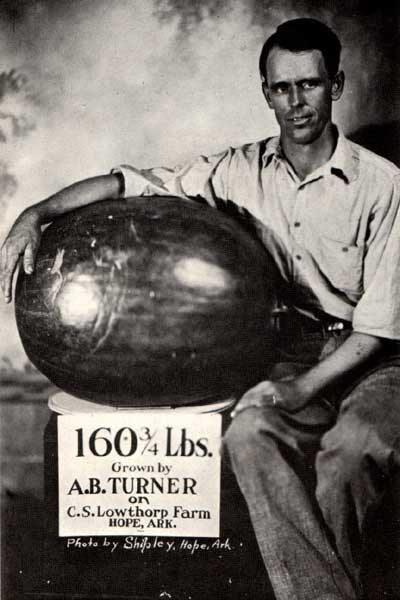
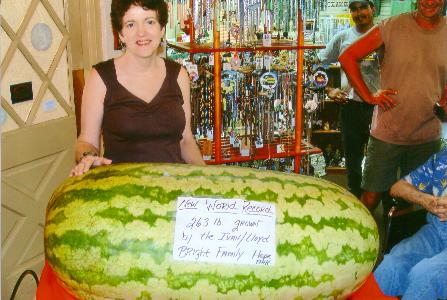
1930 - A.B. Turner and "Jumbo" - This was the 1st of 3 record size watermelons for the year. The final record watermelon was brought in by O.D. Middlebrooks on October 18, 1930 and it weighed 164 & 3/4 pounds. Due to the Great Despression, the 1930 festival was the last at Hope until the 1970s.
Blogaulaire - I'm outta here if Hope cancels this year's festival . . if the folks down there think the Great Depression lasted til the '70s, how long do ya figger the next one's gonna drag on fer?

The Dragon's Almanac 2007 - 13 January

0 comments


"Good luck comes like a large watermelon sitting in the middle of a freshly tidied room."

. . (49) Chinese

Photo Courtesy of Blaikie Turner

Campaign for the American Reader: Books and their covers

0 comments

This is a post we archived as a draft. We bring it forward because it hits on some points made in today's other posts. (By coincidence there is mention of last year's publication of the E. L. Doctorow novel "The March".

What I think is pertinent is the ease with which copyright in images is violated to put a book cover together. I am thinking about the digital book world along the lines that Google proposed to the publishing industry last Thursday (at the meeting in the New York City Library). Well I think that even for digitized fiction there will be a need for a digital cover, something attractive and a come-on to potential readers. And the whole thing being pitched as 'free' makes me conclude that all these backlist or even current titles will be 'covered' using unpaid artwork.

Marshal Zeringue could write 'steal' cover designs; Not 'reuse photography', in the text blogged below:


Books and their covers
Friday, January 12, 2007

Jeff Pierce writes at The Rap Sheet:
One of the very first posts I wrote for The Rap Sheet blog had to do with publishers and book jacket designers who, probably through inattention, reuse photography that’s previously fronted one or more other books.

Ever since, I’ve been keeping track of these “copy-cat covers,” and now present two more examples, from UK publishers.

See what he's talking about at: 'Did They Really Think Nobody Would Notice?'

Also on the subject of book covers, Pete Lit has posted on the 'Best and Worst Book Covers' of 2007. The worst cover belongs to E.L Doctorow's The March.

What a great book, what an awful cover. Click over to Pete Lit to see for yourself."


Click on the links to find the source posts mentioned above.

12 January 2007

No Bankruptcy Court in the World Can Stay or Delay Harlequin Romance from Her Appointed Rounds

0 comments


King of the Castle (1978)

The Enchanting Island (nd)


The Sofa (A Belmont title) Some of the far racier stuff, also available (if it passes customs).


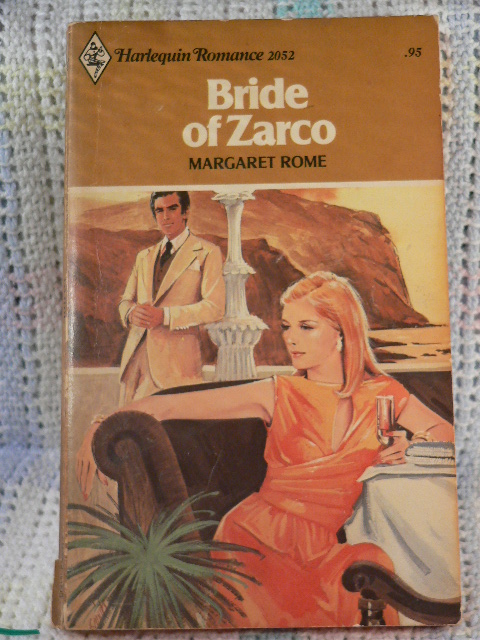
Bride of Zarco by Margaret Rome (c)1976


Where No Roads Go (1963), by Essie Summers. (So rare, Brinks was present.)


Simon & Schuster went to court today to release books from the limbo of possible seizure under Chapter 11 ; we posted a link about one bookseller's take on this issue earlier today.

Upon learning that some/much of what S & S is trying to 'liberate' from AMS's Indiana warehouse consists of recently released Harlequin Romance titles. That got Blogaulaire thinking about how WE could help the Big Publisher in the eventuality that the Harlequin's 'stay stuck on the pallets.

Buy Canadian! Here in the North, we consider Harlequins specifically (and Romance fiction generally) a natural resource, almost like primary resources as 'natural' as paper-pulp and raw nickel.

Canada stands ready to ship every sort of Harlequin: new, old, and middle-aged, to our American cousins in the South. Hell, anything we don't have in Popular Romance Fiction, we'll write for you on the spot we're so good. And the price is dirt cheap: as low as US$4.50 a pop per book (You're welcome to scrounge around (if you buy bulk) in some of the 40-centers, where you might find treasures that can fetch over US $150 from a true collector. You never know!

So to whet the Simon & Schuster appetite and demonstrate that Blogaulaire means business when he speaks for Canadian bookdealers from Coast to Coast all the way north to the Beaufort Sea, we hurried out to OUR warehouse and safe-deposit box for a few sample image uploads running (above) on Cheap Priceless Editions.

Radio Free PGW: PUBLISHERS GROUP WEST, 1976 - 2007

0 comments

RF-PGW Tutors the World About the Sales End of the American Booktrade

Blogaulaire would have blogged todays installment of Radio Free PGW instead of yesterdays. But things are moving quickly into courtroom issues, and we should all know that playing living room coach for a team in litigation is foolish at best.

But on Thursday, 11 Jan 07 the blogger on the inside gave us the dope on how Publishers Group West got its start 30 years ago and how it grew by promoting the sales of the small, independent publishers it represented. He gives names, dates and policy for guiding the sales staff at PGW. Whether this is a guidebook for success or for failure -- I'll let my own readers decide that one.

Simon & Schuster will do what they have to do to promote their own interests, their own titles. Just because their interests are bigger in dollar amount or their titles include Harlequin Romance paperbacks, for Bogaulaire, does not cut it one way or the other. You can be for the 'little guy' all the time and spend all day reading Tolstoy and Proust; in my mind neither 'prejudice' means you go to 'war' with 'pride' or with 'peace' in your heart AGAINST S & S. In fact, I hope the big publishers in this mess and the small press players help each other out at finding beneficial solutions.

A QUOTE from
Radio Free PGW

One of the great contradictions about PGW since Charlie sold it to Satan of San Diego in 2002 is that for many of us, PGW has never been better. Many of us had our best year ever in 2006. Much of the credit for that goes to new PGW president Rich Freese. He was able to take the torch from Charlie and energize an already productive PGW crew. Unfortunately, the sins of AMS would eventually be visited on PGW.

Hard-assed days . .

0 comments

Major Bunny Colvin got tired of all the violence in Baltimore. He got tired of all the shootings, all the innoncents getting victimed, all of the waste of time putting dope on the table. He wanted to make a real difference.


Hard-assed days . . hard-assed ways of learning to live together


Sounds like the story line for any one of a dozen episodes shot on location in Vancouver for DaVinci's Code or some television series that's gritty and real. It's a re-hash of an edisode another blogger would like to see made real in New Orleans. A re-hash with a purpose by Ashley Morris.

We are about to cut out from Cheap Priceless Editions to a blog from a citizen in New Orleans who is fed up with all the killing down there, a young NOLA resident who turns to places like Baltimore or Chicago or anywhere depicted on television or in grit-lit (but also real places) where the police mean business about protecting people's lives from that violent fringe, the craziest victims and self-deluded 'redeemers' of the hard drug trade . . carrying guns.

If you cannot bear to see the word 'fuck' on your computer monitor, THEN don't CLICK ON THE LINK. But Blogaulaire thinks that, despite all the macho-man talk (encouraged in music, pop fiction, video and the like), we all should encourage THINKING OUT solutions as down-to-earth implementation of programs: police programs, social programs, community clinics and, yes, public libraries.

A take on season three of 'The Wire' from Ashley Morris, who I thank for this:

Bunny decided he’d take a different track.


Bunny lectured his troops on how, in the 1950s, a “civic compromise” was struck between the guys drinking a 40 or some Thunderbird on the corner and the police. The drinkers would put their beverage in a bag, and the police would pretend not to notice.

No harm, no foul.

This allowed the drinkers to continue what they were doing, as long as it didn’t hurt anyone; and allowed the police to spend their time on more important issues.

To implement his plan, Bunny found an abandoned stretch of row houses. It shouldn’t be too hard to find something similar in New Orleans these days. He rounded up all the corner boys, all the dope slingers, all the mid-level dealers, and took them to this area. He told them that in this area, they could sell all the dope they wanted. The police would not interfere, and would, in fact, stand watch to make sure the place didn’t get violent. The corner boys had to leave their guns at home, though.

The Dragon's Almanac 2007 - 12 January

0 comments

Hippie Jewelry


from Justin Wintle

"Never talk pygmie to a dwarf."

. . (46) Chinese

11 January 2007

HM Rivergroup - IRISH Software Publisher Gobbled Houghton Mifflin

0 comments

The real question is whether any corporate take-over in textbook publishing will change the 'educational culture'. I suppose that without changing the 'corporate culture' of the business, content and pedogogic creativity becomes a moot point.

This post is just a reminder that we have some substantive checking to do, after we catch up with this name change. Sorry, I apologise to the faculty members; I caught on only and exactly one month after this occured.

Poets&Writers, Inc.

Houghton Mifflin, the Boston-based publisher of books by Jhumpa Lahiri and Philip Roth, as well as the 'Best American' series of anthologies, was recently acquired by the Irish educational software company Riverdeep Holdings for $1.75 billion.

Riverdeep, which is actually the smaller of the two companies, was able to purchase Houghton Mifflin, the fourth-largest textbook publisher in the United States, by securing private investment and assuming over $1.5 billion in debt. The new company will be known as HM Rivergroup.

Houghton Mifflin, which was created by the 1880 merger of publishers Ticknor and Fields and Henry Houghton’s Riverside Press, publishes poets Donald Hall and Glyn Maxwell and fiction writers Tim O’Brien and John Edgar Wideman, among others. The company was owned by three private investment groups, which bought it in 2002 from the French media conglomerate Vivendi for approximately $1.7 billion.


What Vivendi did and did not own, who owns it now (especially which Canadians are still in it), all of this extends my comprehension to the limits. Sitting in Québec, I have the feeling that the corporate stakeholders in publishing with names like Transcontinental and Quebecor World, the names that change little, may turn out to be the biggest players. Maybe it is more important to first ask who prints your phone book and then ask who publishes your child's textbook to have a feel for where this is all going.
(-: my Smiley with a quizzical expression. :-)
posted 12.04.06 "

Cheap Priceless Editions: I'm 'Goody Two-Shoes'

2 comments

FILED: Next to Norman Mailer's "Advertisements for Myself"
--------- and thanks to Sarah's Books Used & Rare (click title) for reminding me what 'Goody Two-Shoes' means literally ---------

I'm 'Goody Two-Shoes'


From smallfry at the end of November to big guy in mid January, in the blogosphere for a mere month and a half, Cheap Priceless Editions is in the news and in your views.

If the number of visitors doubles again, just running ads here will (would if we ran them) bring in US $1.95 !!!

A full-blooded, bona fides blogger-member of MetaxuCafé -- the litblog network that stands high on respected blogrolls in 'our' sphere -- let's tone this down a notch -- in other words, this guy said of the blog you're on, Cheap Priceless Editions the following:

I have never commented, so, I wanted to take the time and let you know even though I don’t comment, I READ you all the time, and LOVE THIS BLOG!

Checkhov's Mistress

No wonder I am being visited daily by the 'Scouts' at Grey Advertising. Yoo hoo!

Mother of a nation: LIBERIAN President Johnson-Sirleaf

0 comments

By Ruthie Ackerman | Contributor to The Christian Science Monitor

'ARE YOU IN SCHOOL?' Ellen Johnson-Sirleaf talks to a group of children outside a church in Monrovia, Liberia, to see if they're going to school. In 2005, she became the first woman elected to lead an African nation.
RUTHIE ACKERMAN


MONROVIA, LIBERIA – At the First United Methodist Church in downtown Monrovia, President Ellen Johnson-Sirleaf sits in the front row for the Sunday morning service, wearing a golden robe and headdress befitting a queen.
Hours later, she wears white sneakers and a baseball cap as she dribbles a soccer ball across a soccer stadium, showing off some of the moves she learned as an 8-year-old girl on an all-boy soccer team.


'Instead of telling them "We're going to build you a school," we ask them, "What is your priority?"
- Ellen Johnson-Sirleaf


"This is reconciliation," she says, aware that most people in the crowd probably voted for her opponent, soccer star George Weah, in Liberia's 2005 presidential election. But her presence at the soccer game proved something more than just her athletic prowess: It showed her willingness to try to bridge the gap between opposing political parties and bring strong leadership to Liberia, a country still devastated by a 14-year civil war that ended in 2003.

These dichotomies - athlete/intellectual, fierce fighter/ nurturer, Harvard-educated economist/African leader, technocrat/feminist - are what give Ms. Johnson-Sirleaf a unique perspective, both as the leader of Liberia and as the first democratically elected female head of state on the continent . . . Yet, how can she realistically restore her nation with an $80 million annual budget and a $3.7 billion debt?

Answer: Slowly.

Looking to the Peace Corps for help


The United States Peace Corps is one way the president says she hopes to recruit teachers to teach the 50 percent of Liberian children who aren't attending school. She also would like to see the 450,000 Liberians currently living outside the country - a group she calls Liberia's biggest national asset - to return home.

"Most of our talents that are out there in the diaspora, once we get them back, then we have the basic ingredient to be able to move our development agenda," she says.

But the president is aware that there are still many impediments for Liberians wishing to return: a lack of good schools and good healthcare, to name two.

With so many major celebrities focusing on Africa - Angelina Jolie, Bono, Madonna - and Hollywood movies choosing Africa as their subject - "Blood Diamond," "The Last King of Scotland," "The Constant Gardener"

- Johnson-Sirleaf says the hot-button issue right now is poverty. "[Poverty] becomes the No. 1 priority, the one thing that needs to be addressed if you're going to really achieve your development goals, and I think that has brought to the forefront a whole new sensitization about how we do development," she says.

Permission to reprint/republish can only be granted by The Christian Science Monitor. See their representative.

Oklahoma family needs: $33,000

0 comments

Life at America's bottom wage
The House is to (did) vote Wednesday on a minimum wage of $7.25 an hour.


In an unrelated ("UNrelated, my rear-end," says Bogaulaire over my left shoulder. "Look at my sidebar, my profile, idiot!")

Okay: Two days ago. in an article unconnected to anything else posted immediately above or below in this column, The Christian Science Monitor ran staff writer Mark Trumbull's fine piece about living on the minimum wage in the US, and I quote the copyeditor in the title:

"Oklahoma family's needs: $33,000"


Oklahoma doesn't have high living costs, compared with some other states. But to cover the basic needs of a family of four here (the Hosiers, are the example) typically requires an income of more than $33,000, according to an online budget calculator created by the liberal Economic Policy Institute in Washington.

At $5.15 an hour, it would take three full-time jobs for a family to earn that much.Many minimum-wage workers, it's true, don't have children. Often they are young people on their first job.

But the Hosier family is not unusual.

On Reading The Xian Sci Mon

0 comments

Cross-listed under

Rmbling Thots of BLGaire


-------- whose been running into far too many Caucasians with Jamaican accents and full-blown Caribbean patois lately -------- and whose own Black Irish roots are starting to tremble in foreboding anticipation of the next wet spring

I know, I'm not a very sophisticated reader if I even 'think' about religion when I read the CSM. We will never, ever see a news magazine run under the name The Unitarian-Universalist Gleaner, and if we did I will not guarantee that I would want to read it. ((Would such a putative UUG have the soul to dig the Latin vibes of . . . The ecstatic religious experiences in the Church of . . . )) Well does The Christian Science Monitor? I'll let that go, sorry.

But then, if I'm blunt, slow and a certified cretin for even hinting at religion when I think about dropping by a Christian Science Reading Room for a free read of their own print news, our friend George over at Bookninja is an even greater nincompoop when he blogs an item on free evening classes being run by local TO anarchists. George starts doing a riff on throwing bombs. (Sorry George, I almost had a bar fight with my best friend over that one long ago, and I cannot let it pass).

Neither can I let a good article on Madam president Johnson-Sirleaf pass when I see Ruthie Ackerman writing in The Christian Science Monitor. (Ms Ackerman, do you happen to know if she (their prez) needs a French tutor (moi) so that she can better get on with Madam Gbagbo in neighbouring Côte d'Ivoire? I know a guy who would jump at the opportunity of tutoring Johnson-Sirleaf.)
Internet reading of CSM is free, no subscription required. CLICK THE TITLE